
Dark store inventory management is the process of receiving, storing, tracking, auditing, and replenishing products in a fulfilment centre that serves online orders rather than walk-in customers.
In quick commerce, inventory management directly affects order fulfilment, product availability, picking productivity, customer experience, and stock loss. A product may appear available in the app but be missing from its assigned shelf. Another product may be physically present but incorrectly recorded in the inventory system.
These discrepancies can create order cancellations, picking delays, unnecessary replenishment requests, and avoidable operational costs.
A well-managed dark store needs more than a stock management system. It requires disciplined receiving procedures, accurate shelf placement, regular stock verification, timely replenishment, and clear accountability for discrepancies.
This guide explains how dark store inventory management works, how to conduct stock audits, how to calculate inventory accuracy, and how managers can investigate common inventory problems.
The procedures and examples below are intended as practical operational guidance. Individual quick commerce companies may follow different systems, audit frequencies, and standard operating procedures (SOPs).
What Is Dark Store Inventory Management?
Dark store inventory management is the systematic control of products from the moment stock arrives at a facility until it is picked for an online order or otherwise removed from available inventory.
Read more about the Dark Store Manager: Role, Responsibilities & Salary to understand how inventory control fits into daily store management.
Unlike a conventional retail store, a dark store is organised primarily around online order fulfilment. Employees must locate products quickly while maintaining accurate system stock.
Diagram Flow of Inventory Management;
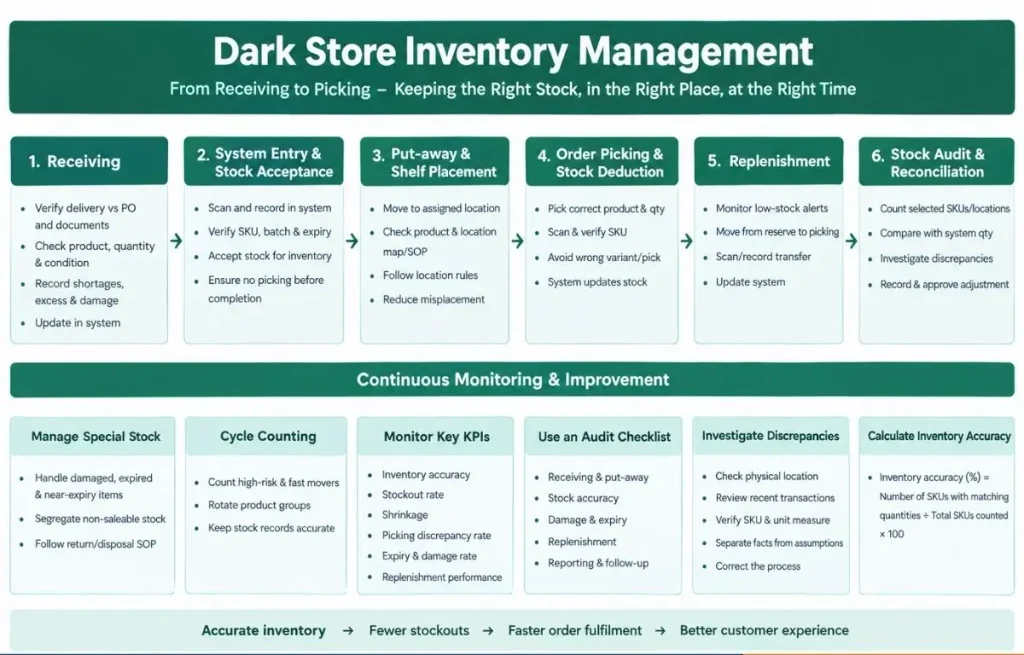
- The main activities include:
-
Inbound receiving: Checking delivered merchandise against purchase orders or delivery documents.
-
Put-away: Moving accepted stock to the correct storage location.
-
Inventory tracking: Recording stock movements in the inventory management system.
-
Order picking: Selecting the correct products and quantities for customer orders.
-
Cycle counting: Physically counting selected products and comparing them with system records.
-
Stock replenishment: Moving products from reserve storage to picking locations.
-
Inventory discrepancy management: Investigating differences between physical stock and recorded stock.
-
Damage and expiry control: Identifying products that must be removed from saleable inventory.
The objective is to keep physical stock, system stock, and available-to-sell quantities aligned.
For example, if the inventory system shows 20 units of cooking oil but only 16 saleable units are physically available, the four-unit difference needs investigation. Simply changing the system quantity may correct the displayed balance, but it does not explain why the discrepancy occurred.
How Does Inventory Move Through a Dark Store?
Understanding the complete stock movement process helps managers identify where errors originate.
Step 1: Inbound receiving
When a delivery arrives, the receiving team verifies the merchandise against the relevant purchase order, invoice, delivery challan, or other approved document.
Checks may include:
-
Product name and SKU.
-
Delivered quantity.
-
Packaging condition.
-
Batch or lot details, where applicable.
-
Expiry or best-before information, where relevant.
-
Damage, leakage, or missing units.
Any shortage, excess delivery, or damaged merchandise should be documented according to the company’s receiving SOP.
Operational example: If a supplier document lists 100 units but the team receives 96, the shortage should be recorded and investigated before the full quantity is accepted into available inventory.
Recording 100 units without verifying the delivery can create an inventory discrepancy from the beginning.
Step 2: System entry and stock acceptance
Once the delivery is verified, accepted quantities should be recorded in the appropriate system.
The exact process depends on the technology used by the business. Some facilities use barcode scanning, while others may have additional verification or approval steps.
The important control is that accepted stock should not become available for picking before the required receiving and system-entry steps are complete.
Step 3: Put-away and shelf placement
After receiving, products are moved to designated storage or picking locations.
A location may be identified by an aisle, rack, shelf, bin, or a combination of these.
Correct put-away helps employees find products quickly and reduces the risk of stock being misplaced.
For example, if a product is physically placed on Shelf B but the system records it at Shelf D, an employee searching the expected location may report the product as missing even though it exists elsewhere in the store.
A good put-away process verifies both the product and its destination.
Step 4: Order picking and stock deduction
When an online order arrives, the picking team selects the required products.
The system should reflect the stock movement at the appropriate stage of the order process, according to the company’s workflow.
Potential errors include:
- Picking two units when the order requires one.
- Selecting the wrong product variant.
- Scanning one SKU while physically picking another.
- Placing picked merchandise in the wrong order tote.
- Failing to complete a required scan or transaction.
These mistakes can affect inventory accuracy as well as order accuracy.
Step 5: Replenishment
When the picking location becomes low on stock, products may need to be transferred from reserve storage to the active picking shelf.
Replenishment should follow the system’s location and quantity records. Where the physical reserve stock does not match the recorded balance, the discrepancy should be investigated rather than repeatedly transferring quantities that do not exist.
Step 6: Stock audit and reconciliation
Inventory checks compare physical stock with recorded quantities.
When differences are found, the responsible team investigates possible causes, records the evidence, and processes approved corrections.
This completes the control cycle, although stock monitoring and reconciliation continue throughout the day.
How to Conduct a Dark Store Stock Audit
In my tenure i have been part of various stock audit (stock take). In Retail store it happen on Quarterly basis from third party auditor (agency).
A dark store stock audit verifies whether the quantity recorded in the inventory system matches the physical saleable stock.
The following process can be adapted to daily operations.
Step 1: Prepare the audit list
Select the SKUs or locations to be counted.
Priority can be given to products with frequent stock discrepancies, fast-moving items, recent adjustments, high damage rates, or repeated picking failures.
The selection should reflect the site’s risk and audit policy rather than relying on the same small group of products indefinitely.
Step 2: Identify the correct SKU and location
Confirm the product description, SKU or barcode, pack size, and assigned storage location before counting.
Similar packaging can cause confusion between different variants or quantities. A product with the correct brand but the wrong size is still an inventory error.
Step 3: Count physical stock
Count the units physically present at the designated location.
Where the operating procedure requires it, count reserve stock and other approved locations separately. This helps distinguish a genuine shortage from misplaced merchandise.
For reliable results, a blind count can be useful: the person counting does not see the system quantity before completing the physical count. This reduces the risk of unintentionally matching the count to the expected figure.
\Step 4: Compare physical and system quantities
Record the system quantity and physical count, then calculate the difference.
Inventory variance = Physical quantity − System quantity
A negative variance indicates fewer units than recorded. A positive variance indicates more physical units than recorded.
For example:
- System stock: 50 units.
- Physical stock: 46 units.
- Variance: −4 units.
The four-unit difference should be investigated.
Step 5: Investigate the discrepancy
Before making an adjustment, check relevant transactions and locations.
Possible causes include:
- Receiving quantity entered incorrectly.
- Stock placed in the wrong location.
- Picking transactions not completed correctly.
- Incorrect SKU selection.
- Damaged or expired products not processed properly.
- Duplicate or missed inventory transactions.
- Transfers or returns recorded incorrectly.
A recount may be appropriate when the original count is uncertain.
Step 6: Record and approve the correction
Once the cause is established, document the physical quantity, system quantity, variance, investigation findings, and corrective action.
System adjustments should follow the company’s approval process and audit trail requirements.
Step 7: Verify the corrective action
Check whether the discrepancy has been resolved and whether the underlying cause has been addressed.
If the same SKU repeatedly shows a shortage, investigate the process rather than treating every occurrence as an isolated counting error.
What Is Cycle Counting in a Dark Store?
Cycle counting is the practice of physically verifying selected inventory items or locations on a planned schedule instead of counting every product at once.
It helps dark store teams identify discrepancies regularly while normal operations continue.
For example, a manager may organise the day’s count around fast-moving products, items with repeated variances, and a selection of other SKUs.
A practical cycle-counting plan can consider:
| Product or risk category | Suggested approach |
|---|---|
| Fast-moving products | Prioritise according to movement and discrepancy history |
| Products with repeated variances | Count more frequently until the cause is controlled |
| High-value merchandise | Apply the site’s risk-based audit policy |
| Slow-moving products | Include in a planned rotation |
| Damaged or expiry-sensitive stock | Verify status, quantity, and segregation as required |
These are planning suggestions, not universal counting frequencies. Each business should set its own schedule according to stock volume, product risk, staffing, and internal controls.
Why cycle counting matters
Cycle counting can help managers:
-
Detect stock discrepancies earlier.
-
Reduce the number of products reported as missing during picking.
-
Identify recurring receiving and put-away errors.
-
Monitor the effectiveness of corrective actions.
-
Maintain better inventory records without relying exclusively on a full physical stocktake.
The value of cycle counting comes from investigating discrepancies and preventing their recurrence, not simply completing a target number of counts.
How to Manage Inventory Discrepancies
An inventory discrepancy occurs when the physical quantity or status of merchandise differs from the quantity or status recorded in the inventory system.
A useful investigation follows a consistent sequence.
Check the physical location first
Confirm the product is not stored in a different bin, reserve area, or approved holding location.
If the system supports location-level stock, check the relevant locations before concluding that the product is missing.
Review recent stock movements
Examine receiving entries, picks, replenishments, transfers, returns, damage records, and adjustments around the time the difference may have occurred.
The aim is to establish which transaction or process may explain the variance.
Check SKU and unit-of-measure errors
A mismatch can occur when similar products are confused or when a case quantity is recorded incorrectly as individual units.
For example, a case containing 12 individual packs must not be treated as 12 cases unless the system’s unit of measure explicitly requires that interpretation.
Separate confirmed facts from assumptions
An unexplained shortage does not automatically prove theft or employee misconduct.
Record what was counted, which transactions were reviewed, what evidence was found, and what remains unresolved. Escalate suspected policy violations through the appropriate company process.
Correct the process
The appropriate action depends on the cause. Examples include refresher training, improved scanning discipline, corrected shelf labels, a revised receiving check, or a system correction approved by the authorised person.
A useful discrepancy log contains the date, SKU, location, recorded quantity, physical quantity, variance, probable or confirmed cause, action taken, and verification status.
Damaged, Expired and Near-Expiry Inventory
Not every physically present product should be treated as available for customer orders.
Dark store teams need a clear process for identifying and separating merchandise that is damaged, expired, leaking, contaminated, or otherwise unsuitable for sale under applicable requirements and company policy.
The process should include:
- Identify the affected product and quantity.
- Move it to the designated area where the SOP requires segregation.
- Record the correct inventory status.
- Prevent unsuitable stock from being picked for customer orders.
- Complete the required return, disposal, or other authorised disposition process.
- Maintain supporting records.
For products with expiry dates, use the company’s approved stock rotation method. First-expiry-first-out (FEFO) prioritises the product with the earliest expiry date, where applicable and suitable for the product category.
Practical point: If a damaged item remains included in saleable system stock, the inventory may appear accurate by quantity while still being inaccurate by status. Good inventory control therefore checks both how many units exist and whether they are eligible for sale.
Dark Store Stock Replenishment During Peak Hours
Replenishment becomes especially important when order volume rises and picking locations empty quickly.
Poor replenishment can create a situation where reserve stock is available but pickers cannot find the product at the active location.
A practical replenishment process includes:
- Monitoring low-stock alerts or agreed minimum shelf quantities.
- Prioritising products according to demand, current shelf stock, and replenishment lead time.
- Verifying reserve stock before moving it.
- Scanning or recording the transfer where required.
- Placing the product in the correct picking location.
- Updating the system before treating the replenishment as complete.
- Checking that older stock is rotated appropriately.
Managers should also monitor whether replenishment activity obstructs picking routes or creates congestion during busy periods.
Illustrative example
Suppose an active shelf holds 8 units of a product, while its reserve location contains 30 units. If the agreed replenishment trigger is reached, the team may move an appropriate quantity from reserve to the picking shelf.
The actual trigger and transfer quantity should be based on the site’s demand pattern, shelf capacity, replenishment time, and operating rules. There is no single minimum quantity suitable for every product.
Important Inventory Management KPIs
Inventory KPIs help managers identify problems and evaluate whether corrective actions are working.
Inventory accuracy
This measures how closely recorded inventory agrees with physical stock. The calculation method should be clearly defined.
Stockout rate
This measures how often required products are unavailable when needed. A business should define the measurement unit, such as SKU availability, order-line availability, or another consistent measure.
Inventory shrinkage
Shrinkage refers to inventory loss that cannot be fully explained by normal recorded movements. It may arise from damage, errors, theft, or other causes, depending on the business’s definitions and accounting process.
Picking discrepancy rate
This measures inventory or picking-related discrepancies relative to a defined number of picks or order lines.
Expiry and damage rate
This tracks products or stock value affected by expiry, damage, or other specified non-saleable conditions.
Replenishment performance
This measures whether replenishment requests are completed within the site’s defined service target.
For each KPI, managers should document the formula, reporting period, data source, and exclusions. Consistent definitions make comparisons more meaningful.
How to Calculate Inventory Accuracy
A common SKU-level method is to calculate the percentage of audited SKUs whose physical quantities match their recorded quantities exactly.
Formula:
Inventory accuracy (%) = (Number of SKUs with matching quantities ÷ Total SKUs counted) × 100
Worked example
Suppose a dark store audits 100 SKUs during a cycle count. Of these, 92 SKUs have physical quantities that exactly match their system quantities.
Inventory accuracy = (92 ÷ 100) × 100 = 92%
This means 92% of the audited SKUs matched exactly under this measurement method.
The remaining eight SKUs require investigation. The result does not tell the manager the financial value of the variance, the cause of the errors, or whether all other SKUs in the store are accurate.
A different method may calculate unit-level accuracy or compare total inventory value. Those measures can produce different results and should not be presented as interchangeable.
For useful reporting, managers should track both the accuracy percentage and the number, value, and causes of discrepancies.
Practical Dark Store Inventory Audit Checklist
Use this checklist as a starting point and adapt it to your company’s SOP.
Receiving and put-away
- Verify delivered quantities against the approved documents.
- Record shortages, excess quantities, and damaged merchandise.
- Confirm the correct SKU and pack size.
- Verify stock entry in the inventory system.
- Confirm products are placed in their assigned locations.
Stock accuracy
- Count the selected SKUs or locations.
- Compare physical quantities with system quantities.
- Recount uncertain or mismatched quantities where required.
- Review recent transactions for identified discrepancies.
- Document the cause and approved corrective action.
- Verify that corrections are reflected in the system.
Damage and expiry
- Identify damaged and unsuitable merchandise.
- Check expiry information where applicable.
- Segregate non-saleable products according to the SOP.
- Update the correct inventory status.
- Complete required return or disposal records.
Replenishment and reporting
- Check low-stock and replenishment alerts.
- Verify reserve stock before transferring it.
- Confirm the correct picking location.
- Review recurring stockouts and discrepancies.
- Record audit completion and outstanding actions.
- Escalate unresolved issues to the responsible manager.
Common Inventory Management Mistakes to Avoid
Even a well-designed inventory system can produce poor results if operational controls are inconsistent.
Updating stock without investigating: An adjustment can hide a recurring problem if the original cause is never identified.
Ignoring misplaced inventory: A product may exist physically but remain unavailable to pickers because it is stored in the wrong location.
Counting only fast-moving products: High-movement items deserve attention, but the audit plan should also cover other products and locations.
Treating damaged goods as saleable stock: Physical presence alone does not mean an item is suitable for customer fulfilment.
Skipping required scans: Unrecorded movements create differences between system stock and physical stock.
Failing to review repeat discrepancies: Recurring variances often justify a closer review of the process, training, location setup, or system controls.
Using inconsistent KPI definitions: Accuracy figures cannot be compared reliably if teams use different formulas or count different inventory populations.
My Experience
As an operations manager, we always ensure that stock accuracy is maintained through multiple checks and controls across daily operations. Inventory accuracy is not the responsibility of a single person or department; it depends on the discipline followed at every stage, from receiving and put-away to order picking, replenishment, and stock audits.
Multiple verification points help identify discrepancies early and prevent small errors from becoming recurring operational problems. Regular physical stock checks, correct system transactions, location verification, and timely investigation of inventory mismatches are essential parts of this process.
In my experience, simply correcting a stock quantity in the system is not enough. The team must also understand why the discrepancy occurred and take corrective action to prevent it from happening again. Consistent monitoring, clear accountability, and adherence to standard operating procedures help maintain inventory accuracy and support smooth dark store operations.
Frequently Asked Questions
1. What is dark store inventory management?
Dark store inventory management is the process of receiving, storing, tracking, auditing, and replenishing products in a fulfilment facility used to process online orders.
2. Why is inventory accuracy important in quick commerce?
Inventory accuracy helps the business show more reliable product availability, reduce picking problems, investigate stock discrepancies, and plan replenishment more effectively.
3. What is a stock audit in a dark store?
A stock audit compares physical merchandise with inventory system records. It identifies quantity differences that need verification, investigation, and appropriate correction.
4. What is cycle counting?
Cycle counting is the regular physical verification of selected SKUs or storage locations. It helps teams identify inventory errors without necessarily counting the entire facility at once.
5. How is inventory accuracy calculated?
One common method divides the number of audited SKUs with exact physical-to-system quantity matches by the total number of SKUs counted, then multiplies the result by 100. Other measurement methods are possible, so the formula should always be stated.
6. What causes inventory discrepancies in dark stores?
Common causes include incorrect receiving entries, misplaced stock, picking errors, missed transactions, incorrect unit-of-measure entries, damaged goods, and inaccurate transfers or returns.
7. How can a dark store reduce stock discrepancies?
A dark store can strengthen receiving verification, use correct SKU and location scans, conduct risk-based cycle counts, investigate variances, maintain accurate damage records, and review recurring errors.
8. What is FEFO in inventory management?
FEFO stands for first-expiry-first-out. Where applicable, it prioritises products with the earliest expiry date for stock rotation, subject to product suitability and the company’s procedures.
9. What should a manager do when physical stock is lower than system stock?
The manager should verify the count, check other relevant locations, review recent inventory movements, document the cause where it can be established, and process any adjustment through the approved procedure.
10. Which inventory KPIs should a dark store manager monitor?
Useful measures include inventory accuracy, stockout rate, shrinkage, picking discrepancy rate, expiry and damage rate, and replenishment performance. The business should define each metric consistently.
Conclusion
Effective dark store inventory management depends on accurate receiving, correct storage, reliable stock movement records, regular physical verification, and timely replenishment.
A stock audit identifies discrepancies, but the real operational improvement comes from understanding why they happened and preventing them from recurring.
For dark store managers, the goal is not simply to achieve a high inventory accuracy percentage. It is to maintain dependable product availability, support efficient order picking, protect saleable stock, and create a repeatable process that the team can follow every day.
Editorial note: This article provides general operational guidance. Follow your employer’s approved SOPs and applicable requirements for receiving, food safety, stock adjustments, and inventory disposal.