This is where Dark Stores Explained becomes essential for understanding modern quick commerce. Dark stores are specialized fulfillment centers designed exclusively for online order processing and rapid dispatch, acting as the operational backbone of instant delivery platforms.
Unlike conventional retail outlets, dark stores are not open to customers. Instead, they operate as hyperlocal warehouses strategically placed within dense urban areas to enable faster picking, packing, and delivery.
From my experience managing retail and last-mile operations since 2013, I’ve seen firsthand how the shift toward dark store operations has fundamentally changed inventory management, logistics planning, and customer expectations in the quick commerce ecosystem.
In this guide, we will explore:
- What dark stores are
- How they operate
- Why quick commerce companies rely on them
- The economics behind their success
- Operational challenges and best practices
What Are Dark Stores?
A dark store is a retail fulfillment center designed specifically for processing online orders rather than serving walk-in customers.
These facilities are typically located in high-demand urban neighborhoods, allowing delivery riders to reach customers within minutes.
Key Characteristics of Dark Stores
Dark stores differ from traditional stores in several ways:
- Closed to the public
- Optimized for fast order picking
- Located near dense residential areas
- Limited but high-demand product assortment
- Integrated with delivery logistics systems
In the quick commerce ecosystem, a dark store functions as the central hub for instant delivery fulfillment.
Why Dark Stores Are the Backbone of Instant Delivery
The quick commerce model depends heavily on speed. Delivering within 10–20 minutes requires inventory to be stored close to customers.
Dark stores make this possible.
Key Advantages
1. Faster Order Fulfillment
Products are already stored locally, reducing travel time.
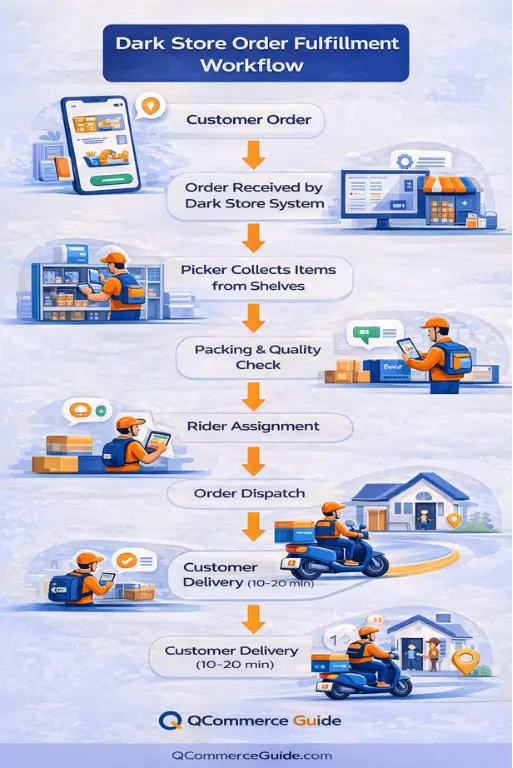
Example workflow:
- Customer places order
- Dark store receives order instantly
- Picker collects items
- Rider dispatches delivery
Total processing time can be as low as 3–5 minutes.
2. Optimized Inventory Management
Dark stores carry high-demand SKUs only.
Typical assortment:
- 1500–2500 SKUs
- High frequency grocery items
- Snacks and beverages
- Household essentials
This allows faster picking and better inventory turnover.
3. Improved Delivery Efficiency
Since dark stores are placed within 1–3 km delivery radius, riders can complete more orders per hour.
This significantly improves:
- Delivery speed
- Rider productivity
- Customer satisfaction
How Dark Store Operations Work
Understanding dark store operations helps explain why they are so effective in quick commerce.
Step 1: Inventory Planning
Operations teams analyze order data to decide which products to stock.
Important factors include:
- Order frequency
- Delivery demand patterns
- Seasonal product demand
Only fast-moving products are stocked.
Step 2: Warehouse Layout Design
Dark stores are designed for speed.
Typical layout sections include:
- Fast-moving product zones
- Cold storage
- Packing stations
- Rider dispatch area
The goal is to minimize picker travel distance.
Step 3: Order Picking
Once a customer places an order, the system generates a picking list.
Pickers use handheld devices or mobile apps to locate items quickly.
Average picking time:
- 60–120 seconds per order.
Step 4: Packing
Orders are quickly packed into delivery bags.
Quality checks include:
- Correct item verification
- Expiry date validation
- Temperature-sensitive packaging
Step 5: Rider Dispatch
Delivery riders are assigned automatically through dispatch algorithms.
They arrive at the dark store, collect the order, and start delivery within minutes.
Dark Store vs Traditional Retail Store
| Feature | Dark Store | Traditional Store |
|---|---|---|
| Customer access | No | Yes |
| Purpose | Online fulfillment | In-store shopping |
| SKU count | 1500–2500 | 5000–15000 |
| Picking method | Staff-based | Customer self-pick |
| Layout design | Speed optimized | Customer browsing |
Dark stores prioritize operational efficiency, while traditional stores focus on customer experience.
The Role of Dark Stores in Quick Commerce Growth
The success of instant delivery platforms depends heavily on dark store networks.
Major quick commerce companies operate hundreds of dark stores across cities.
Typical coverage model:
- One dark store per 2–3 km radius
- Each store serves 2000–3000 households
- Handles 200–500 orders per day
This hyperlocal network enables delivery promises under 20 minutes.
Practical Insights from Industry Experience
Having managed retail and quick commerce operations for more than a decade, several operational realities stand out when it comes to dark stores.
1. Location Is the Most Critical Factor
The success of a dark store depends heavily on its location.
Key considerations include:
- High residential density
- Good road connectivity
- Low rental cost
- Proximity to demand clusters
A poorly located dark store can struggle with low order volumes even in a large city.
2. SKU Selection Drives Efficiency
Stocking too many items slows operations.
Most successful dark stores maintain 2000 SKUs or fewer.
Focus categories include:
- Dairy
- Snacks
- Beverages
- Fresh produce
- Household essentials
These categories generate the majority of orders.
3. Operational Discipline Is Essential
Speed depends on process discipline.
Common operational practices include:
- Strict picking routes
- Real-time inventory updates
- Rider queue management
- Continuous demand forecasting
Without operational discipline, delivery times quickly increase.
4. Staff Productivity Impacts Profitability
Labor efficiency is critical.
Typical staffing structure:
- 3–5 pickers
- 1 store manager
- 8–15 delivery riders
Improving picking speed by even 10 seconds per order can significantly increase daily capacity.
Challenges of Operating Dark Stores
Despite their advantages, dark stores also face several operational challenges.
1. High Urban Rent
Since dark stores need prime urban locations, rental costs can be high.
Operators must balance location advantage vs operational cost.
2. Inventory Accuracy
High order volumes can lead to stock mismatches.
Inventory errors cause:
- Order cancellations
- Customer dissatisfaction
- Refund costs
3. Demand Fluctuations
Order demand can spike during:
- Evenings
- Weekends
- Rainy days
Operations teams must scale staffing accordingly.
4. Delivery Rider Availability
Rider shortages can delay deliveries even when orders are ready.
Efficient rider scheduling is essential.
Future of Dark Stores
Dark stores will continue evolving as quick commerce grows.
Key trends include:
Micro-Fulfillment Automation
Robotics and automated picking systems may reduce labor costs.
AI Demand Forecasting
Machine learning models will improve inventory planning and reduce stockouts.
Hyperlocal Network Expansion
Companies will continue expanding dark store networks to reduce delivery times further.
Frequently Asked Questions (FAQ)
What is a dark store in quick commerce?
A dark store is a retail fulfillment center used exclusively for processing online orders and enabling rapid delivery.
Why are dark stores important for instant delivery?
They store inventory close to customers, allowing orders to be picked and delivered within minutes.
How many products are typically stocked in a dark store?
Most dark stores carry 1500–2500 high-demand SKUs.
Are dark stores profitable?
Profitability depends on order density, operational efficiency, and delivery costs.
Do customers visit dark stores?
No. Dark stores are not open to customers and operate only for online order fulfillment.
Conclusion: Why Dark Stores Power the Quick Commerce Revolution
Understanding Dark Stores Explained helps reveal why instant delivery services have become possible at scale.
By positioning inventory closer to customers and optimizing operations for speed, dark stores enable quick commerce companies to fulfill orders within minutes.
From my experience managing retail and delivery operations over the years, the most successful dark store networks share several characteristics:
- Strategic hyperlocal locations
- Focused product assortment
- Efficient picking processes
- Strong last-mile logistics coordination
As consumer demand for convenience continues growing, dark stores will remain the core infrastructure powering instant delivery ecosystems.
For businesses entering the quick commerce space, mastering dark store operations is not optional—it is essential for building a scalable and profitable delivery network.