How quick commerce works is one of the most misunderstood aspects of modern retail. Customers see a 10-minute delivery promise on their mobile screen, place an order, and receive groceries almost instantly. But behind that convenience lies a highly disciplined operational system built on dark stores, real-time inventory control, last-mile precision, and demand forecasting.
Having worked for over 15 years in retail, grocery operations, e-commerce, and last-mile delivery since 2013, I can confidently say this: quick commerce is not about speed alone — it is about operational synchronization.
In this detailed guide, I will break down how quick commerce works step-by-step, from the moment a customer places an order to the final doorstep delivery.
What Is Quick Commerce?
Quick commerce (Q-commerce) is an ultra-fast delivery model that promises order fulfillment within 10–30 minutes. It focuses on:
- Hyperlocal delivery
- Small order sizes
- High-frequency purchases
- Dark store fulfillment
Unlike traditional e-commerce, quick commerce operates through micro-warehouses located close to customers.
The Core Infrastructure Behind Quick Commerce
Before understanding how quick commerce works operationally, you need to understand its foundational elements.
1. Dark Stores
Dark stores are small warehouses located within residential zones. They:
- Serve 2–4 km radius
- Stock 2,000–5,000 SKUs
- Operate purely for online orders
- Do not allow walk-in customers
Their primary purpose is speed.
2. Technology Backbone
Quick commerce depends heavily on:
- Real-time inventory management
- Demand forecasting algorithms
- Route optimization systems
- Order batching logic
- Rider allocation systems
Without technology synchronization, 10-minute delivery is impossible.
How Quick Commerce Works: Step-by-Step Operations
Now let’s break down the complete operational flow.
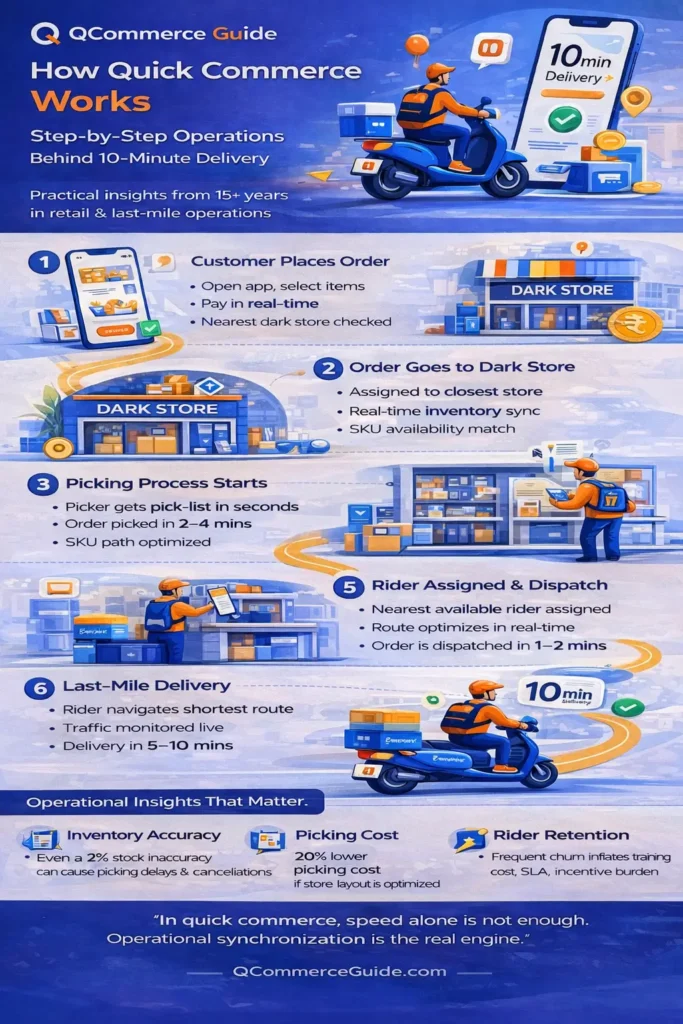
Step 1: Customer Places Order
The process begins when a customer:
- Opens the mobile app
- Selects products
- Completes payment
The app instantly checks:
- Inventory availability at nearest dark store
- Estimated delivery time
- Delivery slot capacity
Operational Insight:
Inventory visibility must be accurate to avoid cancellations and refund losses.
Step 2: Order Allocation to Nearest Dark Store
The system automatically assigns the order to:
- The closest operational dark store
- Based on SKU availability
- Based on current picking load
If stock is unavailable, the app either:
- Hides the product
- Shows limited stock
- Suggests substitutes
This real-time filtering is critical in understanding how quick commerce works efficiently.
Step 3: Picking Process Inside the Dark Store
Once the order is assigned:
- Picker receives notification
- Digital pick list appears
- Optimized pick-path reduces walking time
Typical picking time:
2–4 minutes
Efficiency depends on:
- SKU placement
- Fast-moving items near entrance
- Clear aisle labeling
- Staff training
From my experience, poor shelf organization can increase picking time by 30%.
Step 4: Packing and Quality Check
After picking:
- Items move to packing station
- Barcode scanning confirms accuracy
- Packaging materials added
- Bill printed
Packaging time:
1–2 minutes
Challenges:
- Fragile items
- Cold chain products
- Substitutions
Quality errors at this stage directly impact repeat orders.
Step 5: Rider Allocation and Dispatch
Simultaneously, the system:
- Identifies nearest available rider
- Assigns delivery task
- Shares optimized route
Rider arrives at dark store, collects package, and dispatches.
Dispatch window:
1–2 minutes
High rider density reduces wait time and improves SLA performance.
Step 6: Last-Mile Delivery
The rider:
- Follows shortest route
- Navigates traffic in real-time
- Contacts customer if required
Average delivery time:
5–10 minutes
Total operational window from order to doorstep:
8–15 minutes (depending on zone efficiency)
Step 7: Delivery Confirmation & Feedback Loop
Upon delivery:
- OTP confirmation
- App marks order delivered
- Customer rating requested
- Data logged for analytics
Post-delivery data feeds into:
- Demand forecasting
- Rider performance metrics
- Zone profitability tracking
Practical Insights from Industry Experience
Understanding how quick commerce works requires real-world operational awareness.
Here are some practical lessons from my experience managing last-mile and grocery retail operations:
1. Inventory Accuracy Determines Speed
Even a 2% inventory mismatch leads to:
- Picking delays
- Customer cancellations
- Refund processing
- Wasted rider trips
Inventory discipline is more important than marketing speed claims.
2. Order Density Drives Profitability
High order density means:
- More deliveries per rider per hour
- Lower cost per order
- Better dark store utilization
Low-density zones struggle with profitability regardless of speed.
3. Dark Store Layout Is Critical
Optimized layout includes:
- High-frequency SKUs at front
- Logical category grouping
- Clear signage
- Fast access to cold storage
Poor layout increases labor cost significantly.
4. Rider Retention Impacts SLA
Frequent rider churn causes:
- Delivery delays
- Higher training cost
- Incentive inflation
- Customer dissatisfaction
Retention programs improve operational consistency.
Key Metrics That Power Quick Commerce Operations
To truly understand how quick commerce works, track these metrics:
- Orders per dark store per day
- Average order value (AOV)
- Contribution margin per order
- Picking time per order
- Rider productivity (orders/hour)
- Delivery SLA compliance %
- Order cancellation rate
- Customer repeat rate
Without daily metric tracking, operational gaps grow quickly.
Real-World Example of Efficient vs Inefficient Zone
Zone A:
- 1,500 orders/day
- 2 km radius
- High private label mix
- 95% SLA compliance
Result: Profitable and scalable.
Zone B:
- 500 orders/day
- 4 km radius
- High discount dependency
- 85% SLA compliance
Result: Operational strain and margin pressure.
The difference lies in density, discipline, and data utilization.
Challenges in Quick Commerce Operations
Even though the system appears smooth, operational challenges include:
- Traffic unpredictability
- Rain disruptions
- Rider availability fluctuation
- Inventory shrinkage
- Technology downtime
- Peak-hour spikes
Companies that manage variability win long term.
The Role of Technology in Scaling Operations
AI and automation now help:
- Predict high-demand SKUs
- Optimize rider routes
- Prevent stock-outs
- Improve batching logic
- Forecast peak hours
Technology reduces human error but cannot replace operational discipline.
Future of Quick Commerce Operations
The next evolution includes:
- Automated dark stores
- Electric vehicle fleets
- Micro-fulfillment robotics
- AI demand clustering
- Smart neighborhood hubs
But even with automation, core principles remain:
Inventory accuracy + density + speed discipline.
FAQ: How Quick Commerce Works
1. How do companies deliver in 10 minutes?
By using hyperlocal dark stores and high rider density within a 2–4 km radius.
2. What is a dark store?
A small warehouse dedicated to online order fulfillment only.
3. Why is inventory accuracy important?
Inaccurate inventory causes picking delays and cancellations.
4. What is the biggest operational challenge?
Last-mile delivery cost and rider management.
5. Is quick commerce profitable?
It can be profitable with strong unit economics and high order density.
Conclusion: The Real Engine Behind 10-Minute Delivery
Understanding how quick commerce works reveals that speed is only the visible layer. The real engine behind quick commerce success is operational synchronization between:
- Dark stores
- Inventory systems
- Picking efficiency
- Rider allocation
- Route optimization
- Demand forecasting
From my 15+ years in retail and last-mile operations, I can confidently say that quick commerce success is built on discipline, not just discounts.
The companies that master operational density, control costs, and maintain inventory precision will dominate the future of hyperlocal retail.