The success of quick commerce depends on one critical operational pillar: last-mile delivery strategies in quick commerce. No matter how strong your sourcing, pricing, or app interface is, failure in last-mile execution can break the entire customer promise.
After working across retail, grocery chains, e-commerce, and last-mile delivery networks since 2013, I’ve seen how the shift from next-day delivery to 10-minute fulfillment completely changed operational strategy. What worked in traditional e-commerce simply doesn’t work in quick commerce.
This article breaks down how modern quick commerce companies design, optimize, and scale last-mile operations — with practical insights drawn from real-world retail and logistics execution.
Why Last-Mile Delivery Is the Core of Quick Commerce
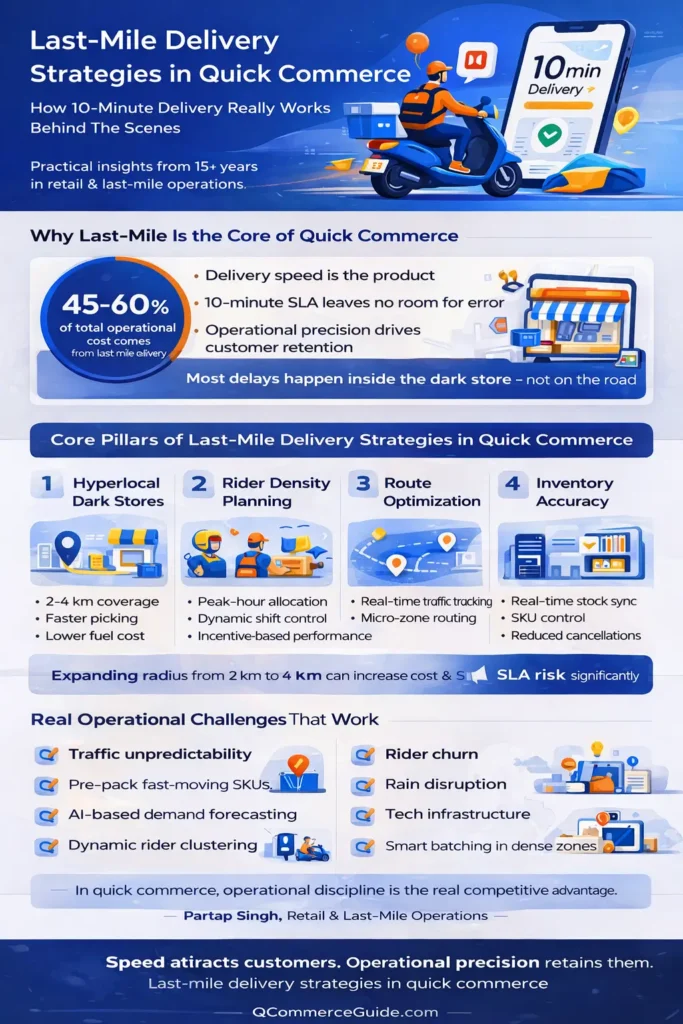
In traditional e-commerce, delivery speed was a competitive advantage.
In quick commerce, delivery speed is the product.
The promise of a 10-minute delivery model means:
- Inventory must be hyperlocal
- Picking must happen within 2–3 minutes
- Dispatch must be immediate
- Riders must be available within a tight radius
This transforms logistics from a backend function into the primary customer experience driver.
In grocery retail operations, we always optimized store replenishment cycles weekly. In quick commerce, operational cycles run hourly.
Understanding Last-Mile Delivery Strategies in Quick Commerce
When discussing last-mile delivery strategies in quick commerce, we are talking about:
- Rider fleet management
- Route optimization
- Dark store positioning
- Order batching vs. single dispatch
- SLA monitoring
- Rider productivity models
Unlike standard e-commerce logistics, quick commerce operates in micro-zones of 2–4 km coverage areas.
Core Components of Quick Commerce Logistics
1. Hyperlocal Dark Store Network
Most quick commerce players rely on dark store operations — small warehouses located inside residential clusters.
Operational benefits:
- Reduced travel time
- Faster picking
- Predictable delivery radius
- Lower fuel cost per order
From my operational experience, location selection is more important than store size. A poorly positioned dark store can increase delivery time by 3–4 minutes — which is massive in a 10-minute model.
2. Rider Density Planning
You cannot scale quick commerce without proper rider allocation.
Key considerations:
- Order volume by hour
- Rain & traffic fluctuations
- Rider shift management
- Idle time vs. service level balance
A common mistake I’ve seen is over-hiring riders to maintain speed. This reduces per-order profitability and increases operational burn.
The smarter strategy is:
- Dynamic rider allocation
- Incentive-based surge management
- Zone-based rider clustering
3. Route Optimization in Hyperlocal Zones
In traditional e-commerce, route optimization focuses on long-distance clustering.
In quick commerce:
- Routes are extremely short
- Traffic unpredictability matters more than distance
- Signal delays impact SLA heavily
Technology must calculate:
- Real-time traffic
- Rider proximity
- Order preparation time
- Delivery ETA prediction
Quick commerce logistics systems often integrate live traffic APIs to constantly adjust dispatch decisions.
Last-Mile Optimization in the 10-Minute Delivery Model
The 10-minute delivery model works only if every minute is controlled:
- Minute 0–1 → Order confirmation
- Minute 1–3 → Picking
- Minute 3–5 → Packing
- Minute 5–6 → Dispatch
- Minute 6–10 → Delivery
Any delay in picking pushes rider wait time. Any rider delay pushes customer dissatisfaction.
Operational truth:
Most delays happen inside the dark store, not on the road.
Practical Insights from Industry Experience
After managing retail operations and observing quick commerce rollouts, here are the real lessons:
1. Inventory Accuracy Is Non-Negotiable
If stock data is incorrect:
- Picker wastes time
- Rider waits
- Customer cancels
Even a 2% stock mismatch can disrupt 10-minute SLAs.
2. Rider Motivation Impacts SLA
Riders are not just delivery agents — they are brand ambassadors.
Low incentive structure leads to:
- Delayed pickups
- Multi-order stacking misuse
- Poor customer interaction
Clear incentive slabs improve performance by 12–18%.
3. Micro-Zone Redesign Improves Efficiency
Expanding delivery radius from 2 km to 4 km increases:
- Delivery time variance
- Rider fuel cost
- Cancellation probability
Smaller zones = better SLA control.
4. Peak Hour Strategy Is Everything
Evening grocery rush (6 PM – 9 PM) determines daily performance.
Successful operators:
- Increase rider density before peak
- Pre-pack high-frequency SKUs
- Enable express dispatch lanes
Order Batching vs. Single Dispatch
A big strategic question in last-mile delivery strategies in quick commerce is:
Should you batch orders?
Single Dispatch:
✔ Faster delivery
✖ Higher cost per order
Order Batching:
✔ Better profitability
✖ Risk of SLA breach
From experience, batching works only if:
- Orders are in same micro-cluster
- Picking times overlap
- Traffic is predictable
Otherwise, it damages customer trust.
Cost Structure of Last-Mile Delivery
Major cost components:
- Rider payout
- Fuel reimbursement
- Dark store rent
- Packing material
- Technology infrastructure
- Return handling
In many quick commerce companies, last-mile accounts for 45–60% of operational costs.
Optimizing this determines long-term sustainability.
Technology’s Role in Last-Mile Optimization
Modern quick commerce logistics depends on:
- AI demand forecasting
- Real-time rider tracking
- Auto-dispatch systems
- SLA breach alerts
- Heatmap analytics
Data-driven decision-making is what separates scalable players from those burning cash.
Real-World Operational Scenario
Let’s say a dark store in Mumbai handles 600 orders daily.
If:
Average delivery time = 14 minutes instead of 10
Customer satisfaction drops
Repeat order rate falls
Even a 2-minute delay impacts:
- NPS score
- Retention
- Word-of-mouth growth
In quick commerce, time = brand perception.
Challenges in Last-Mile Delivery Strategies in Quick Commerce
- Traffic unpredictability
- Rider churn
- Rain disruption
- Order spikes
- Inventory mismatches
- High customer expectations
Unlike traditional retail, recovery time is almost zero.
Future of Last-Mile in Quick Commerce
Emerging trends:
- Electric vehicle fleets
- AI-driven dispatch engines
- Dark store automation
- Smart locker micro hubs
- Drone pilots (experimental)
The future belongs to companies that balance speed with cost efficiency.
FAQ: Last-Mile Delivery in Quick Commerce
1. Why is last-mile delivery expensive in quick commerce?
Because orders are small, distances are short, and speed expectations are high, increasing cost per delivery.
2. How do dark stores improve delivery speed?
They reduce travel time by positioning inventory close to customers.
3. Can batching work in 10-minute delivery?
Yes, but only in dense zones with smart routing logic.
4. What is the biggest operational risk?
Inventory mismatch and rider shortages during peak hours.
5. Is 10-minute delivery sustainable?
Only if last-mile optimization and cost control are tightly managed.
Conclusion: The Real Secret Behind Quick Commerce Success
The backbone of sustainable growth lies in well-designed last-mile delivery strategies in quick commerce.
Speed alone is not enough.
Success requires:
- Hyperlocal fulfillment
- Smart rider management
- Data-driven optimization
- Tight inventory control
- Peak hour planning
From my years in retail and last-mile operations, one lesson is clear:
In quick commerce, operational discipline is the competitive advantage.
Companies that master execution — not just marketing — will dominate this space.