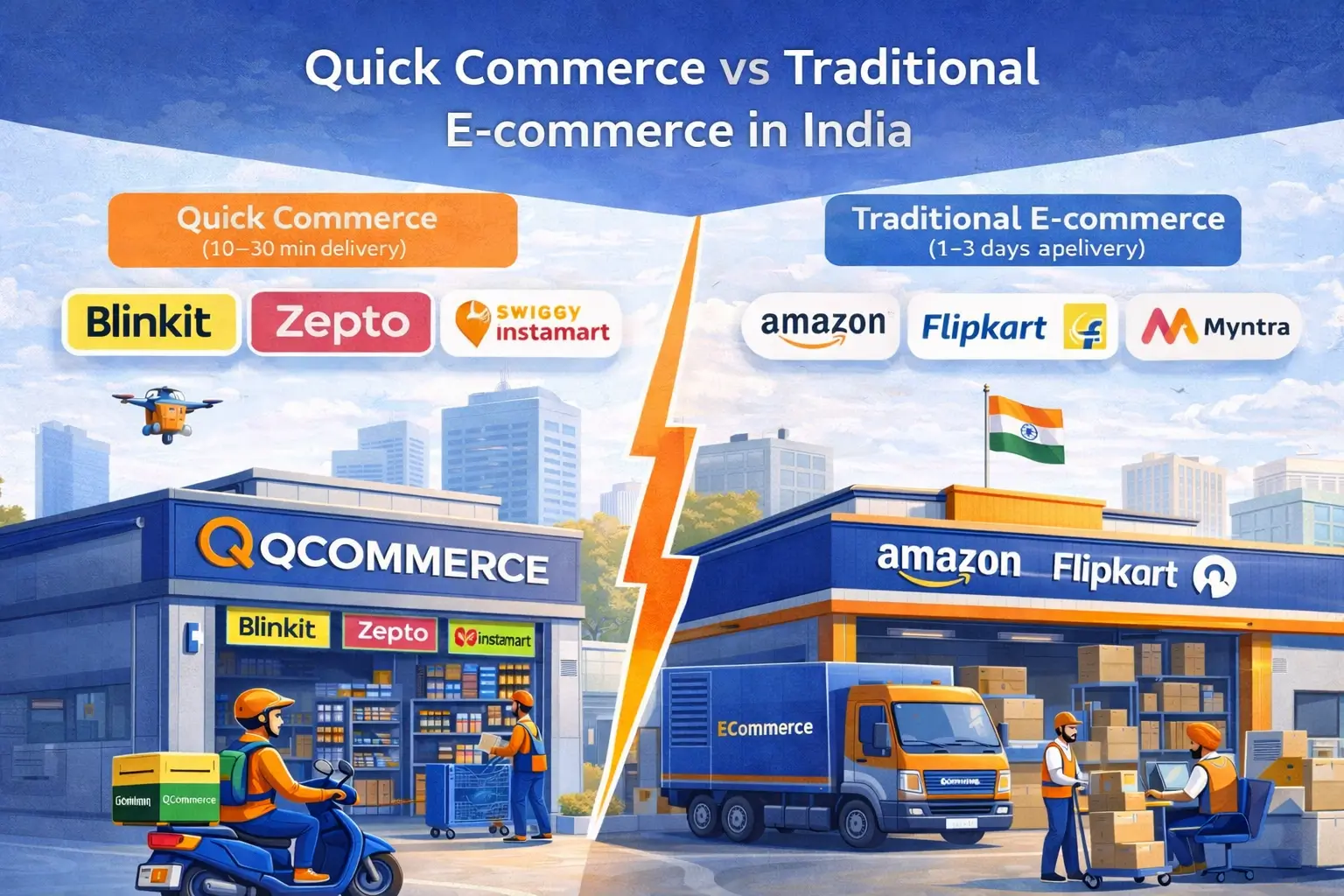
Online retail has evolved rapidly over the past decade, giving rise to two major models: Quick Commerce and Traditional E-commerce.
While both operate within the digital retail ecosystem, their delivery models, infrastructure, and operational strategies are fundamentally different.
From my experience working in grocery retail, e-commerce operations, and last-mile delivery since 2013, I have seen how consumer expectations around speed have dramatically changed. Earlier, customers were comfortable waiting a few days for delivery. Today, many expect essential items to arrive within 10–30 minutes.
This demand for instant convenience has driven the growth of quick commerce platforms powered by hyperlocal dark stores and fast delivery networks.
If you’re new to the concept, you may want to first read our guide on [What is Quick Commerce?] to understand how the model works.
In this article, we will explore the key differences between Quick Commerce and Traditional E-commerce, including logistics, delivery speed, inventory management, and real-world operational challenges.
What Is Quick Commerce?
Quick Commerce (often called Q-Commerce) is a retail model designed for ultra-fast delivery, usually within 10–30 minutes.
Instead of fulfilling orders from large warehouses, quick commerce companies rely on small fulfillment hubs called dark stores located close to customers.
If you want a deeper explanation, read our detailed guide on Dark Stores Explained: Backbone of Instant Delivery.
These facilities are designed specifically for fast order picking and dispatch, not for customer shopping.
Key Characteristics of Quick Commerce
• Delivery within 10–30 minutes
• Limited assortment of 1,500–3,000 SKUs
• Dark store infrastructure
• Hyperlocal delivery zones (2–4 km radius)
• Focus on daily essentials
Typical quick commerce categories include:
- Groceries
- Dairy products
- Snacks
- Personal care items
- Household essentials
This model prioritizes speed and convenience over product variety.
What Is Traditional E-commerce?
Traditional e-commerce refers to the standard online retail model where customers order products online and receive delivery within 1–3 days or scheduled delivery slots.
Orders are usually fulfilled from large warehouses or regional fulfillment centers.
Unlike quick commerce, these platforms focus on large assortment and price competitiveness.
Key Characteristics of Traditional E-commerce
• Delivery time: 1–3 days
• Very large product assortment
• Centralized warehouse fulfillment
• Nationwide shipping networks
• Lower delivery cost per order
Traditional e-commerce platforms typically offer millions of products, making them ideal for non-urgent purchases.
Quick Commerce vs Traditional E-commerce: Key Differences
1. Delivery Speed
The most obvious difference between the two models is delivery time.
Quick Commerce
• 10–30 minute delivery
• Instant order processing
• Hyperlocal delivery network
Traditional E-commerce
• 1–3 day delivery
• Scheduled shipping
• Regional distribution networks
Quick commerce is designed for immediate needs, while traditional e-commerce supports planned purchases.
For more insight into delivery operations, you can read our guide on Last-Mile Delivery in Quick Commerce.
2. Fulfillment Infrastructure
The operational infrastructure behind each model is very different.
Quick Commerce Infrastructure
Quick commerce companies operate dense networks of dark stores and micro-fulfillment centers across cities.
These stores are typically placed every few kilometers to enable rapid delivery.
If you’re interested in how these facilities operate, explore our article on Micro-Fulfillment Centers in Modern Retail.
Traditional E-commerce Infrastructure
Traditional e-commerce relies on:
• Large centralized warehouses
• Regional distribution centers
• National courier networks
This model focuses on economies of scale rather than delivery speed.
3. Product Assortment
Product assortment is another major difference.
| Model | SKU Range |
|---|---|
| Quick Commerce | 1,500 – 3,000 |
| Traditional E-commerce | Thousands to millions |
Quick commerce focuses on high-frequency items that customers purchase regularly.
Traditional e-commerce platforms provide a much wider product selection.
4. Inventory Management
Inventory management plays a critical role in both models.
However, quick commerce requires near-perfect stock accuracy because orders must be fulfilled instantly.
From my operational experience managing retail inventory systems, even small inventory mismatches can create delays or order cancellations in quick commerce environments.
This is why real-time inventory tracking systems are essential for dark store operations.
You can learn more about this in our article on Inventory Management in Quick Commerce.
Traditional e-commerce warehouses, on the other hand, can manage inventory more flexibly due to longer delivery timelines.
5. Delivery Radius
Quick Commerce
• 2–4 km delivery radius
• Rider-based logistics
• Hyperlocal delivery network
Traditional E-commerce
• Nationwide delivery coverage
• Courier shipping networks
• Regional fulfillment hubs
Quick commerce focuses on urban micro-markets, while traditional e-commerce serves large geographic areas.
Practical Insights from Industry Experience
Running quick commerce operations is far more complex than many people realize.
Over the years, I have seen several operational challenges emerge while managing retail and last-mile operations.
1. Store Layout Impacts Picking Speed
Dark stores must be organized for fast picking routes, similar to warehouse picking systems.
High-demand products should be placed closer to packing stations to reduce picking time.
2. Rider Availability Determines Delivery Speed
Even if the order is packed quickly, deliveries can be delayed if riders are unavailable during peak hours.
Balancing rider supply with demand is a key operational challenge in quick commerce logistics.
3. Demand Forecasting Is Difficult
Quick commerce demand fluctuates based on:
- Time of day
- Weather conditions
- Local events
- Weekends and holidays
Accurate forecasting helps improve inventory planning and rider scheduling.
When Customers Prefer Traditional E-commerce
Despite the rise of quick commerce, traditional e-commerce still dominates many retail categories.
Customers prefer traditional e-commerce when purchasing:
• Electronics
• Fashion
• Furniture
• Bulk items
• High-value products
These purchases require larger product selection and price comparison, which traditional e-commerce handles better.
The Future of Online Retail
The future of retail will likely involve hybrid models combining quick commerce and traditional e-commerce.
Many retailers are now integrating:
• Dark stores
• Micro-fulfillment centers
• Large regional warehouses
This allows them to offer:
- Instant delivery
- Same-day delivery
- Scheduled delivery
Retailers that successfully combine these systems will be best positioned to meet modern consumer expectations.
FAQ
What is the main difference between quick commerce and traditional e-commerce?
Quick commerce focuses on instant delivery within minutes, while traditional e-commerce usually delivers products within 1–3 days.
Why do quick commerce companies use dark stores?
Dark stores allow retailers to store products closer to customers, enabling faster picking and delivery.
Can traditional e-commerce companies offer quick commerce?
Yes. Many retailers are launching micro-fulfillment centers and dark stores to support instant delivery.
Conclusion
Understanding the differences between Quick Commerce vs Traditional E-commerce helps retailers, logistics professionals, and entrepreneurs better navigate the evolving digital retail landscape.
Quick commerce is optimized for speed and convenience, powered by hyperlocal fulfillment networks and rapid delivery logistics.
Traditional e-commerce, on the other hand, focuses on scale, assortment, and nationwide distribution.
Both models will continue to coexist, and the retailers that integrate them effectively will lead the next phase of online retail innovation.