The unit economics of quick commerce determine whether a 10-minute delivery business becomes profitable or burns cash endlessly. While quick commerce companies attract customers with speed and discounts, sustainable growth depends entirely on understanding cost per order, contribution margin, and operational efficiency at the micro level.
After 15+ years working across retail, grocery operations, e-commerce, and last-mile delivery since 2013, I’ve seen one consistent truth: speed attracts customers, but unit economics decides survival.
In this detailed guide, I will break down the real numbers, cost drivers, operational challenges, and profitability levers that define the unit economics of quick commerce.
What Is Unit Economics in Quick Commerce?
Unit economics refers to the revenue and cost structure per individual order.
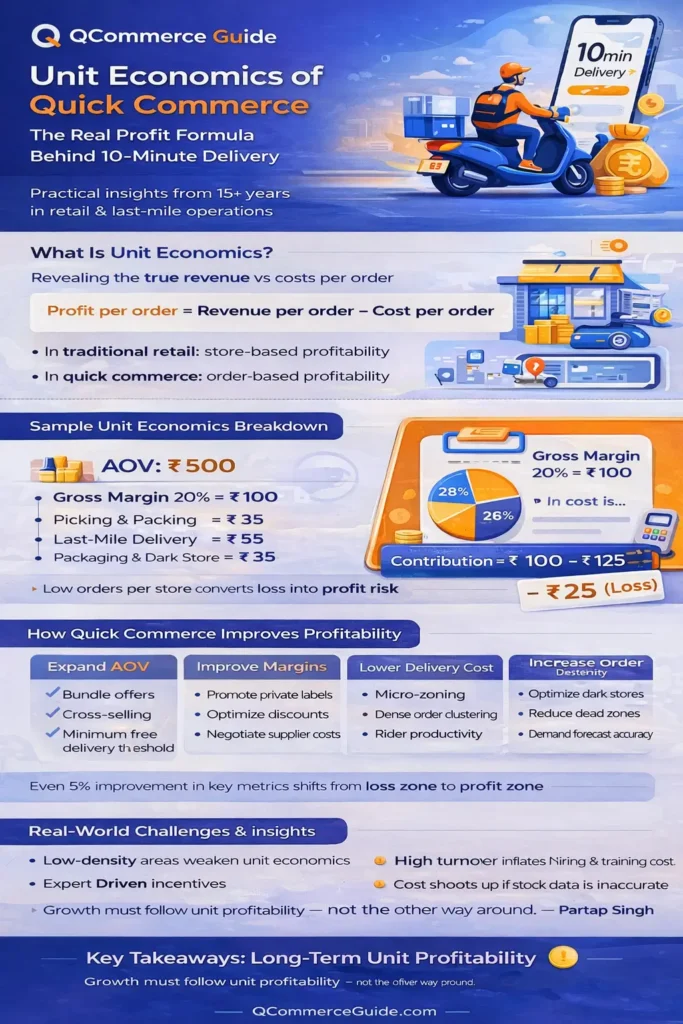
In simple terms:
Profitability = Revenue per order – Total cost per order
In traditional retail, profitability is store-based.
In quick commerce, profitability is order-based.
Each 10-minute delivery must:
- Cover picking & packing cost
- Cover last-mile delivery cost
- Cover dark store overhead
- Cover tech & platform cost
- Still leave contribution margin
If even one layer is inefficient, the entire model collapses.
Why Unit Economics of Quick Commerce Is So Critical
Quick commerce operates on:
- Low average order value (AOV)
- High operational intensity
- Hyperlocal infrastructure
- Thin margins
Unlike traditional e-commerce, you cannot rely on:
- Large cart sizes
- Cross-city fulfillment
- Cheap warehouse cost
- Long delivery windows
Instead, the model demands operational precision.
Core Components of Unit Economics of Quick Commerce
Let’s break down the major components.
1. Average Order Value (AOV)
AOV is the revenue generated per order.
Typical quick commerce AOV in India:
₹350 – ₹600
Lower AOV means:
- Higher cost pressure per order
- Limited room for discounting
- High sensitivity to delivery cost
Operational Insight:
Increasing AOV by even ₹50 can significantly improve contribution margin.
2. Gross Margin
Gross margin comes from:
- Product margin (15–25% in grocery)
- Private label margins (25–40%)
- Category mix optimization
Categories with better margins:
- Snacks
- Beverages
- Personal care
- Private label essentials
Low margin categories:
- Staples
- Fresh produce
- Dairy
Margin mix directly impacts the unit economics of quick commerce.
3. Picking & Packing Cost
Dark store operations include:
- Staff salaries
- Equipment
- Rent
- Utilities
- Inventory carrying cost
Picking cost per order usually ranges:
₹15 – ₹30
Packing cost:
₹10 – ₹20
Total handling cost per order:
₹25 – ₹50
Operational reality:
High SKU complexity increases picking time and cost.
4. Last-Mile Delivery Cost
This is the largest cost component.
Includes:
- Rider payout
- Incentives
- Fuel / EV charging
- Insurance
- Fleet management
Average last-mile cost:
₹40 – ₹70 per order
Delivery radius directly affects cost:
- 2 km zone = lower cost
- 4 km zone = higher SLA risk + cost
This is where most quick commerce companies struggle.
5. Technology & Platform Cost
Includes:
- App development
- Cloud infrastructure
- Routing algorithms
- Customer support tech
While this cost is distributed across orders, it still impacts unit economics when scale is low.
Sample Unit Economics Breakdown (Illustrative)
Let’s assume:
AOV: ₹500
Gross margin: 20% → ₹100
Costs:
- Picking & packing: ₹35
- Delivery: ₹55
- Packaging material: ₹15
- Dark store overhead allocation: ₹20
Total cost: ₹125
Contribution per order:
₹100 – ₹125 = -₹25 (Loss)
This is why many quick commerce startups initially operate at a loss.
How Companies Improve Unit Economics of Quick Commerce
Improvement happens through operational discipline.
Increase AOV
- Bundle offers
- Cart value threshold for free delivery
- Cross-selling
- Category upselling
Improve Gross Margin
- Promote private labels
- Reduce dependency on low-margin staples
- Optimize supplier negotiations
Reduce Delivery Cost
- Micro-zoning
- High order density
- Rider clustering
- Smart batching
Improve Dark Store Productivity
- SKU rationalization
- Fast-moving SKU pre-pack
- Pick-path optimization
Each 5% efficiency improvement matters.
Practical Insights from Industry Experience
Over the years managing retail and last-mile operations, I’ve seen several real-world patterns.
1. Density Beats Speed Marketing
Companies focusing only on speed struggle.
True profitability comes from:
- High order density per dark store
- Optimized rider utilization
- Stable demand forecasting
Without density, unit economics collapse.
2. Inventory Accuracy Impacts Margins
Inventory mismatch leads to:
- Order cancellations
- Refund cost
- Wasted rider effort
- Customer churn
Even a 2% inventory inaccuracy can damage profitability significantly.
3. Expansion Kills Economics if Premature
Opening dark stores too fast:
- Increases rent burden
- Reduces order density
- Raises cost per order
Sustainable growth requires zone-wise profitability tracking.
4. Rider Churn Increases Hidden Costs
Frequent rider turnover means:
- Training cost
- Lower productivity
- SLA risk
- Incentive pressure
Retention programs improve economics more than incentive wars.
Real-World Scenario: Profit vs Loss Zone
Zone A:
- 1,200 orders/day
- 2 km coverage
- High repeat customers
- Private label penetration 18%
Result: Positive contribution margin.
Zone B:
- 450 orders/day
- 4 km coverage
- Heavy discounts
- Low margin mix
Result: Negative contribution margin.
The difference is not speed — it is density and discipline.
Key Metrics to Track in Quick Commerce
To maintain healthy unit economics of quick commerce, track:
- Contribution margin per order
- Cost per delivery
- Orders per dark store per day
- AOV trend
- Category margin mix
- Rider productivity (orders/hour)
- Order cancellation rate
- Customer repeat rate
If these are not tracked daily, losses accumulate silently.
The Role of Scale in Unit Economics
Scale improves:
- Fixed cost absorption
- Supplier negotiation power
- Tech cost distribution
But scale without efficiency multiplies losses.
Growth must follow unit profitability — not the other way around.
Long-Term Sustainability Strategy
For quick commerce to become sustainable:
- Focus on hyperlocal dominance
- Improve private label mix
- Use AI for demand forecasting
- Optimize micro-zone operations
- Reduce dependency on heavy discounting
The future belongs to companies that master micro-economics, not marketing hype.
FAQ: Unit Economics of Quick Commerce
1. Why is quick commerce struggling with profitability?
Because high last-mile cost and low AOV compress margins.
2. What is the biggest cost in quick commerce?
Last-mile delivery, followed by dark store overhead.
3. How can AOV improve profitability?
Higher AOV spreads fixed costs across more revenue per order.
4. Is quick commerce sustainable long term?
Yes, if unit economics are positive at zone level.
5. What metric matters most?
Contribution margin per order.
Conclusion: The Truth About Unit Economics of Quick Commerce
The unit economics of quick commerce is the real engine behind 10-minute delivery models. Speed, branding, and funding may drive growth initially, but only disciplined cost control, margin optimization, and operational density ensure survival.
From my experience in retail and last-mile operations since 2013, sustainable quick commerce depends on:
- Zone-level profitability
- Delivery density
- Inventory discipline
- Margin mix optimization
- Rider productivity
The future of quick commerce belongs to operators — not marketers.