
Picker is the single most common entry point into quick commerce work in India, and also one of the least understood roles by people applying for it. Having worked around dark store staffing and floor operations for years, I’ve watched a lot of new hires walk in expecting something closer to a regular retail floor job, only to realize in the first shift that it’s a faster-paced, more structured, and more physically demanding role than the listing made it sound.
This guide covers what the role actually involves day to day — including the shift structure and specific tasks I’ve seen firsthand — real salary numbers, and how to actually apply.
What a Picker Actually Does
As per the PBI GIG workforce are expected to reach at 2.35 crore by 2029–30.
A Picker’s core job is locating and retrieving the exact items on a customer’s order from shelves inside the dark store, guided by a handheld scanner or a picking app that routes the fastest path through the dark store.
But in practice, the role covers more ground than “picking” alone suggests. Based on what I’ve observed across dark store floors, a Picker’s actual day-to-day work typically breaks into three distinct types of tasks:
- Order picking — the core task: retrieving items against live customer orders as they come in, racing against the platform’s delivery-time promise on every single order
- Stacking stock — restocking shelves from inbound inventory during quieter windows, keeping high-velocity SKUs positioned for the fastest possible pick path, and making sure fast-moving items don’t run into gaps mid-shift
- Audits of merchandise — periodic stock counts and shelf-level checks to catch discrepancies, near-expiry items, or misplaced SKUs before they become a picking error or a shrinkage write-off
New hires are usually told about the first task in detail during onboarding and left to figure out the other two on the floor — which is one of the more common gaps I’ve seen between what people expect walking in and what the job actually is.
The Shift Structure of Pickers
Dark stores generally run three shifts to cover round-the-clock demand, and this is worth understanding clearly before you apply rather than discovering it after joining:
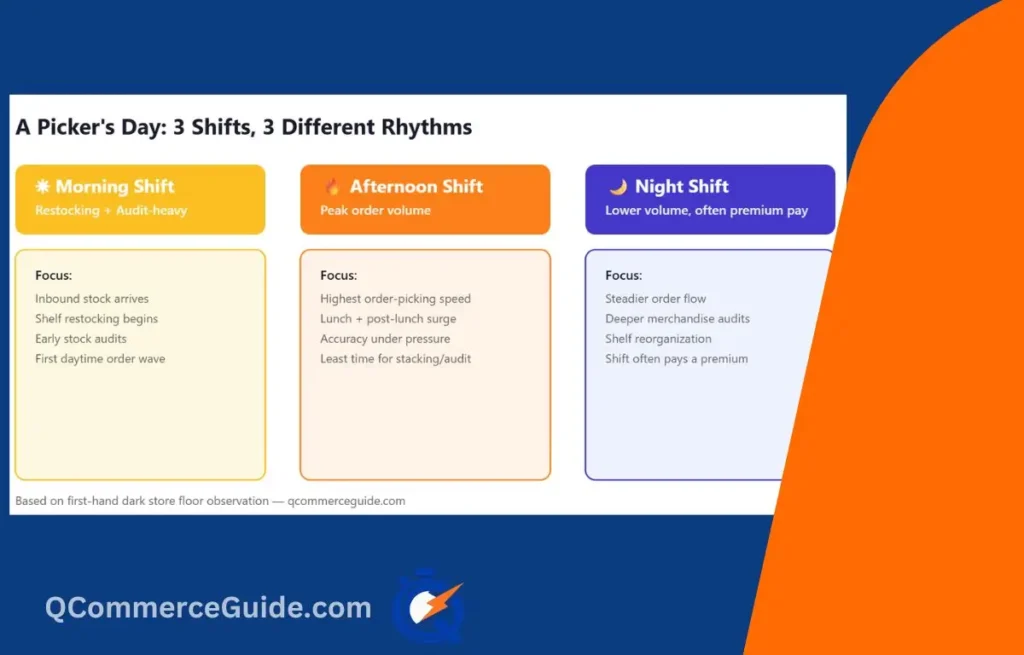
- Morning shift — typically the store’s restocking and audit-heavy window, since inbound deliveries and stock replenishment tend to land earlier in the day, alongside the first wave of daytime orders
- Afternoon shift — usually the highest order-volume window, driven by lunch-hour and post-lunch ordering patterns, with picking speed and accuracy under the most pressure
- Night shift — lower order volume but still active, and often carries a pay premium in listings; also commonly used for deeper stock audits and shelf reorganization that’s harder to do during high-traffic hours
Shift rotation policy varies by store and platform, and this is genuinely one of the most important things to clarify before accepting an offer — new hires who don’t ask about rotation upfront are, in my experience, the ones most likely to feel blindsided a few weeks in.
Eligibility
The bar to apply is intentionally low, since the job doesn’t require prior formal experience:
- Educational qualification: 10th pass, or below 10th in many listings
- Age: typically 18 to around 31, though this varies by listing and city
- Basic reading and communication skills — enough to follow picking instructions and safety guidelines
- Physical fitness — the job involves standing, walking, and lifting through the full shift
- Aadhaar card and bank account details for onboarding and payroll
- No prior experience required for entry-level positions; some listings prefer candidates with warehouse, retail, or logistics background but don’t require it
Real Salary Ranges
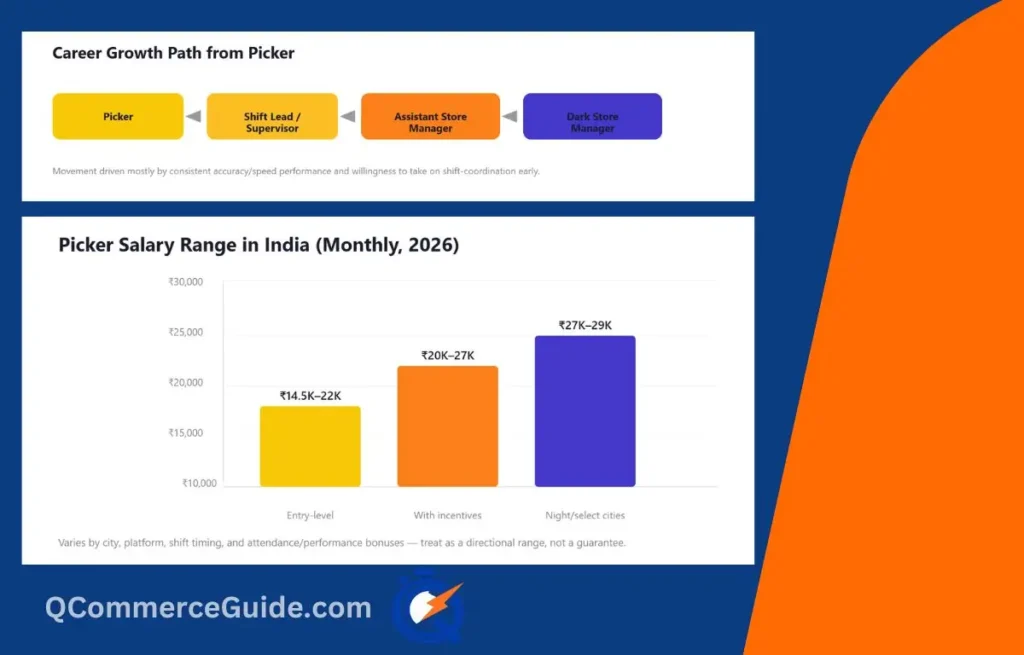
This is the part where online searches get inconsistent fast, so it’s worth being specific about the range rather than quoting one number. Based on current job listings and platform-reported data across Blinkit, Zepto, and Swiggy Instamart:
| Source/City pattern | Monthly Salary Range |
|---|---|
| Entry-level, most cities | ₹14,500–₹22,000 |
| With incentives/attendance bonus | ₹20,000–₹27,000 |
| Higher-paying listings (select cities/shifts, often night shift) | ₹27,000–₹29,000 |
A few honest notes on why the range is wide: pay varies by city (metro vs tier-2), by platform, by shift timing (night shifts sometimes carry a premium, consistent with what I’ve generally seen on the floor), and by whether the listing includes attendance and performance incentives on top of base pay.
Treat any single number you see quoted online — including in this table — as a starting point to verify against the specific listing you’re applying to, not a guarantee.
In our dark store salary depends upon; Experience, Shift & OPD as well.
How to Actually Apply
There’s no single official portal that covers all three platforms, so the practical routes are:
- Job aggregator apps — Apna, Job Hai, Indeed, and WorkIndia are where most Picker listings for Blinkit, Zepto, and Instamart actually get posted, often by local hiring partners or staffing agencies rather than the platforms directly. Filter by “Picker” or “Warehouse” and your city.
- Direct platform career pages — Blinkit runs a dedicated warehouse-partner careers page; Zepto and Instamart list similar openings through their own careers sections, though volume varies a lot by city and is generally lower than what you’ll find on aggregator apps.
- Walk-in applications at dark stores — in some cities, dark stores hire directly on a walk-in basis, especially during rapid expansion phases. If there’s a store near you, asking in person is a legitimate route, though it depends entirely on whether that specific store has open headcount.
- Staffing/manpower agencies — a meaningful share of Picker hiring in this industry runs through third-party staffing agencies rather than the platforms’ own HR teams, which is why you’ll often see the same role listed under different company names for the same platform.
The interview itself, where there is one, tends to be short and practical — basic eligibility confirmation, a quick check of physical fitness for the role, and sometimes a brief on-the-spot task to assess comfort with a scanner or app-based instructions.
Important: Beware of Fake Job Offers
Job seekers should be careful when responding to online picker-job advertisements.
Do not share sensitive banking information, OTPs, UPI PINs or passwords with unknown individuals.
Be especially cautious if someone promises a guaranteed job and asks for money for:
- Registration
- Interview
- Joining
- Security deposit
- Training
- Uniform
- ID card
Always verify the employer and the job opportunity through a reliable source before making any payment or sharing sensitive information.
Growth Path from Here
Picker is generally the entry point into a broader operations career track in quick commerce, not a dead end.
A common progression looks like Picker → Shift Lead/Supervisor → Assistant Store Manager → Dark Store Manager, with movement driven mostly by consistent accuracy and speed performance plus a willingness to take on shift-coordination responsibility early.
If long-term growth in this space interests you, our guide on the Dark Store Manager role, responsibilities, and salary lays out what that path looks like further along.
Full-Time vs Part-Time Picker Jobs
Quick-commerce companies increasingly offer different working arrangements.
Full-time
A typical full-time dark-store role may involve:
- Fixed working hours
- Approximately 8–9 hours per shift
- Weekly off
- Monthly salary
- Attendance/performance incentives
Blinkit’s current Picker Onboarding information describes a full-time option involving a fixed schedule and a 9-hour working day with one weekly off.
Part-time
Part-time work may offer:
- Flexible shifts
- Shift booking through an app
- Weekly payments in applicable arrangements
- Performance-based earnings
The exact availability depends on the city and store.
Picker/Packer Job Interview Questions
Most entry-level interviews are relatively straightforward.
You may be asked:
Q1. Have you worked in a warehouse before?
If you’re a fresher, simply explain that you’re willing to learn.
Q2. Can you work rotational shifts?
Be honest about your availability.
Q3. Can you use a smartphone?
Basic smartphone knowledge is normally sufficient.
Q4. Are you comfortable standing and walking during your shift?
The role requires physical activity, so answer honestly.
Q5. Why do you want this job?
A simple answer could be:
“I am looking for a stable job opportunity and I am interested in warehouse and quick-commerce operations. I am comfortable learning the picking and packing process and working in shifts.”
Author Experience
This article is based on practical experience in retail, e-commerce, grocery retail, quick-commerce and last-mile operations.
The operational examples are intended to help job seekers understand how picker roles function in a real dark-store environment.
Specific duties, shifts, eligibility requirements and compensation vary by employer and location.