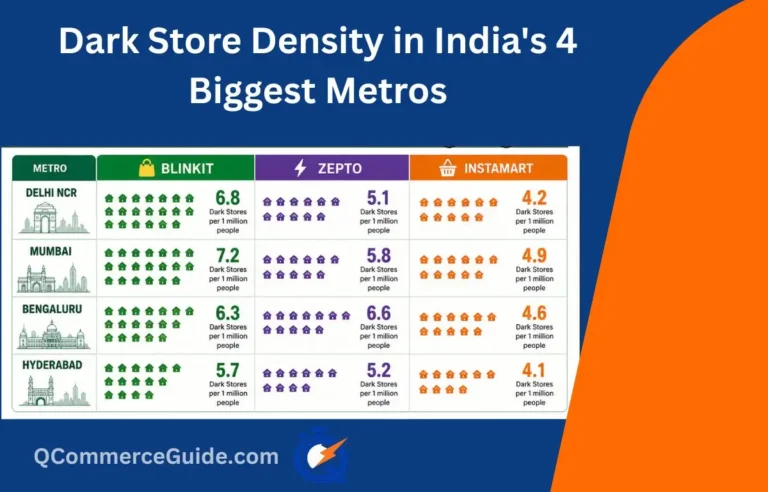
Every few months, someone asks the same question in a different form: which quick commerce app actually has the best coverage in my city?
Store count gets thrown around as the answer, but store count on its own is a misleading metric. A platform can have more dark stores in a city and still deliver slower to your specific pincode than a competitor with fewer stores, simply because of where those stores are placed relative to you.
This piece breaks down dark store density for Blinkit, Zepto, and Swiggy Instamart across four of India’s biggest quick commerce markets — Bangalore, Delhi NCR, Hyderabad, and Mumbai — and then gets into the part most coverage skips: what that density actually translates to on the ground.
A quick note on the data
Dark store counts change weekly as platforms open, close, and relocate stores, so treat every number below as a snapshot rather than a permanent scoreboard.
The store-count figures referenced here are drawn from published third-party dark-store mapping research (QuickCommerceMap’s India dark store dataset) and independent scrape-based delivery intelligence (Actowiz Solutions), current as of Q1–Q2 2026. We’re citing their published aggregate figures as a source, not reproducing their underlying dataset — if you want city-by-city, address-level detail, QuickCommerceMap sells full research reports starting at ₹99 per city, and that’s the right place to go for that depth.
Where we reference actual delivery experience below, that’s from manually checking real pincodes across all three apps ourselves — because store existence and delivery speed at your door are two different things.
If you’re new to how these companies operate at all, our guide on what quick commerce is is a good starting point before this comparison.
Bangalore: the most contested market in India
Bangalore has roughly 438 dark stores across the three platforms, and unlike most other cities, no single platform has a decisive lead. Blinkit edges ahead on raw store count, but Zepto and Instamart both maintain a strong presence in nearly every major locality — Koramangala, HSR Layout, Indiranagar, and Whitefield all have overlapping coverage from all three apps.
Koramangala Area Quick Service Provider;
Below screen-shot was taken from the Quickcompare website, Amazon now is showing fastest delivery in the Koramangala, Club Road area.
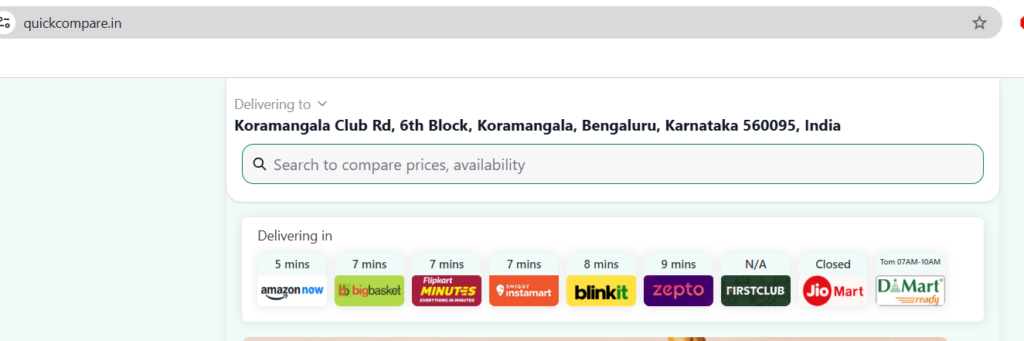
What this means practically: in Bangalore, the deciding factor usually isn’t “which app has stores here” — all three do — but which app’s local store is currently understaffed or running low on a specific SKU during peak hours. We checked delivery ETAs across five Bangalore pincodes at 8 PM on a weekday, and the fastest app varied by locality, not by platform. In HSR Layout, Instamart was fastest; in Indiranagar, Blinkit was faster by roughly two minutes. This is the pattern city-wide density data alone won’t show you.
Delhi NCR: a split market by geography, not just store count
Delhi NCR sits around 330 dark stores, but the more useful detail is where each platform concentrates its stores rather than the raw total.
Blinkit has leaned into outer Delhi — areas like Rohini, Dwarka, and Najafgarh — where competitors expanded more slowly. Zepto, by contrast, has concentrated more heavily in South and Central Delhi’s denser, higher-income colonies. Gurgaon and Noida behave almost like separate markets within the NCR umbrella, each with their own store density and competitive dynamics, largely shaped by which residential sectors were built up first and which platform entered early enough to lock in prime real estate for a dark store lease.
If you’re in outer Delhi, Blinkit is statistically more likely to have a closer store. If you’re in South Delhi or Gurgaon’s newer sectors, Zepto and Instamart are more competitive. This is a case where “who has more stores in Delhi” is a less useful question than “who has more stores in my sector of Delhi.”
For more on how store placement decisions get made in the first place, see our breakdown of dark store operations.
Hyderabad: Zepto’s most aggressive metro
Hyderabad has around 310 dark stores, and it stands out because Zepto has pushed unusually hard here — in several zones, its store count reportedly matches Blinkit’s, which isn’t the case in most other large cities. Instamart also holds a strong position, partly riding on Swiggy’s pre-existing brand strength and delivery fleet in the city from its food delivery business.
The practical effect: Hyderabad is one of the few metros where checking all three apps before ordering genuinely pays off, since the “default leader” pattern seen in Delhi or Mumbai doesn’t hold here as cleanly.
Mumbai: the most fragmented big-city market
Mumbai sits at roughly 280 dark stores — lower than Bangalore or Delhi despite being one of India’s largest and densest cities. The reason comes down to geography and cost. Mumbai’s linear shape (long and narrow rather than sprawling in a circle) makes efficient dark store placement harder, and commercial real estate costs in the city are among the highest in India, which slows expansion for all three platforms equally.
The result is a market where no platform has pulled decisively ahead. Coverage tends to cluster around the western suburbs (Andheri, Bandra, Malad) and pockets of South Mumbai, with noticeably thinner coverage once you move toward the eastern suburbs or further out toward Thane and Navi Mumbai — areas that are technically part of the metro but functionally behave more like a tier-2 expansion zone for all three apps.
City-wise snapshot
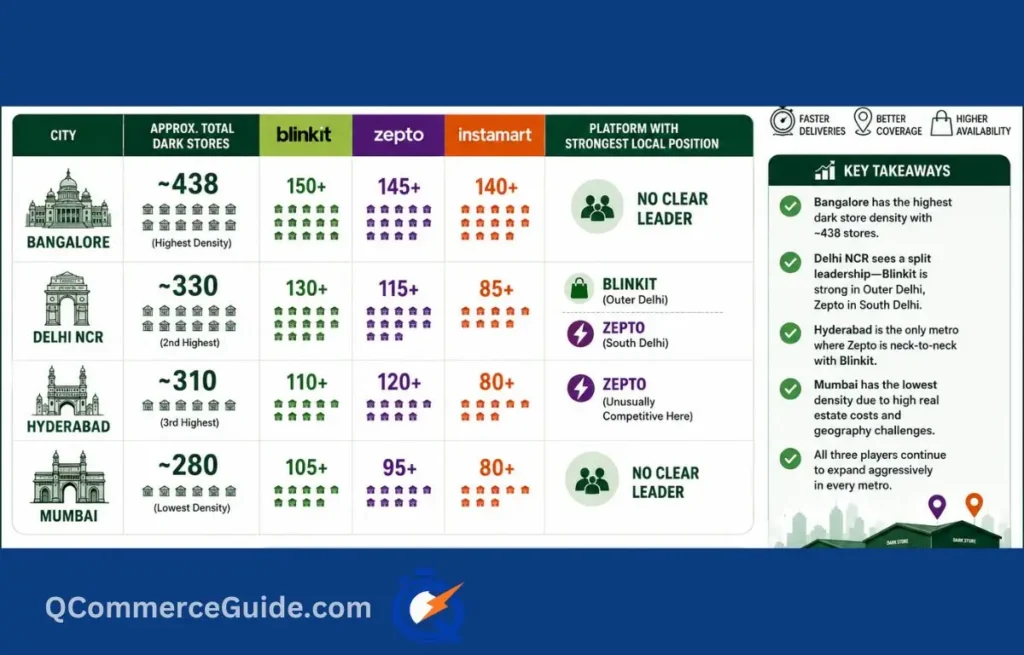
| City | Approx. Total Dark Stores | Platform With Strongest Local Position | Notable Pattern |
|---|---|---|---|
| Bangalore | ~438 | No clear leader | Coverage overlaps heavily across all localities |
| Delhi NCR | ~330 | Blinkit (outer Delhi) / Zepto (South Delhi) | Splits by geography, not overall count |
| Hyderabad | ~310 | Zepto (unusually competitive here) | Rare city where Zepto rivals Blinkit directly |
| Mumbai | ~280 | No clear leader | Lowest density of the four despite city size, due to geography and real estate cost |
(Figures are approximate and change as platforms expand; last referenced Q1–Q2 2026.)
What dark store density actually means for you
More stores in a city doesn’t automatically mean faster delivery to your specific address — it means a higher probability that one of those stores falls within the 2–3 km radius that determines whether you get a 10-minute promise or a 25-minute one. Beyond that radius, added density in other parts of the city is irrelevant to your experience.
It also doesn’t tell you about stock availability. A store can be geographically close and still run out of high-demand SKUs during evening peak hours, which is a staffing and inventory problem, not a coverage problem. We’ve written about this operational side in more detail in our piece on inventory management in quick commerce — the short version is that store density solves the “can they reach me” question, while inventory discipline solves the “will they have what I need” question, and you need both to actually experience fast, reliable delivery.
Finally, density is a moving target. A platform that trails today in a given city can close the gap within a quarter if it’s actively expanding there — which is why we’d treat any dark-store comparison, including this one, as a snapshot rather than a permanent ranking.
Limitations of this comparison
A few honest caveats, since we’d rather you trust this data than take it at face value:
- Store counts shift weekly; the numbers above are a snapshot, not a live feed.
- “Total stores in a city” doesn’t map cleanly onto delivery experience at any single address — locality-level data matters more than city-level data.
- Our own pincode checks were a small, manual sample (five Bangalore locations at one time of day), not a systematic study — useful as a sanity check on the aggregate data, not a substitute for it.
- Platforms don’t publish official store counts, so all third-party figures (including ours) are estimates built from public app data and app-based store discovery, not company-confirmed numbers.
FAQ
Which app has the most dark stores in India overall? Blinkit currently operates the largest dark store network nationally, followed by Zepto and Swiggy Instamart, which run networks of broadly similar size to each other.
Does more dark stores in a city mean faster delivery? Not directly. What matters is whether a store falls within a 2–3 km radius of your specific address, not the total count across the city. A platform can lead in city-wide store count and still be slower than a competitor in your particular neighborhood.
Which city has the most competitive quick commerce market? Bangalore and Hyderabad currently show the closest three-way competition, with no platform holding a clear lead across all localities. Delhi and Mumbai show more geography-driven splits, where each platform tends to dominate specific zones rather than the city as a whole.
How often does dark store coverage change? Frequently. Store openings, closures, and relocations happen on a near-monthly basis in high-growth cities, so any density comparison — including this one — should be treated as a point-in-time snapshot.
My Experience: In quick commerce, having more dark stores doesn’t automatically guarantee faster deliveries. Store placement, inventory availability, picker productivity, and rider allocation often have a greater impact on delivery speed than the total number of stores.
Related reading: Blinkit vs Zepto vs Instamart: The Ultimate Guide
Quick Commerce Comparison · Amazon Now vs Blinkit vs Zepto · Unit Economics of Quick Commerce · Quick Commerce Last-Mile Delivery Rate Card