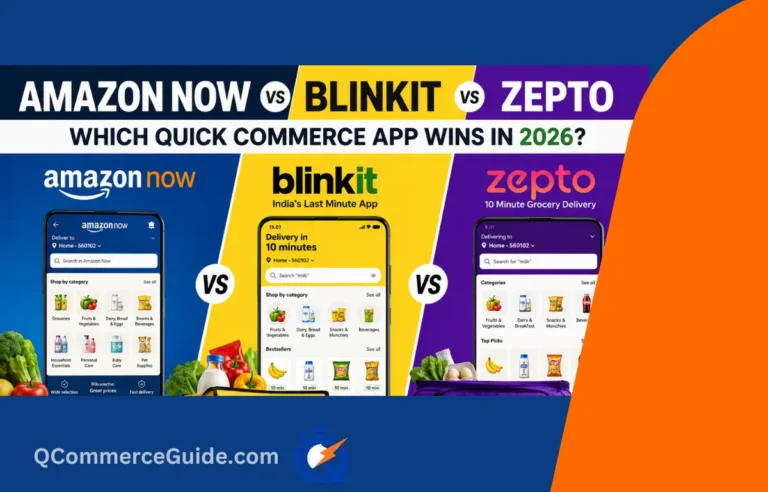
India’s quick commerce war just got its most powerful new contestant. On April 27, 2026, Amazon announced the expansion of Amazon Now to 100 cities across India — backed by a ₹2,800 crore investment and a network of over 1,000 micro-fulfilment centres. For the first time, the largest e-commerce company in the world is directly competing with India’s homegrown quick commerce giants on their own turf.
But Blinkit and Zepto are not sitting still. Blinkit now operates 2,100+ dark stores with a target of 3,000 by March 2027, and commands roughly 45% of India’s quick commerce market. Zepto, the startup that invented India’s 10-minute delivery culture, has crossed 1,100 dark stores and processes over 1.7 million orders daily.
So which app should you actually use — or invest your brand dollars in? We put all three head-to-head across seven key factors, using data from official filings, analyst reports, and our own 15+ years of retail and supply chain experience.
💡
Short on time? Jump to Section 7 for a direct recommendation table that matches the right app to your specific situation — city, use case, and priorities.
Amazon Now vs Blinkit vs Zepto
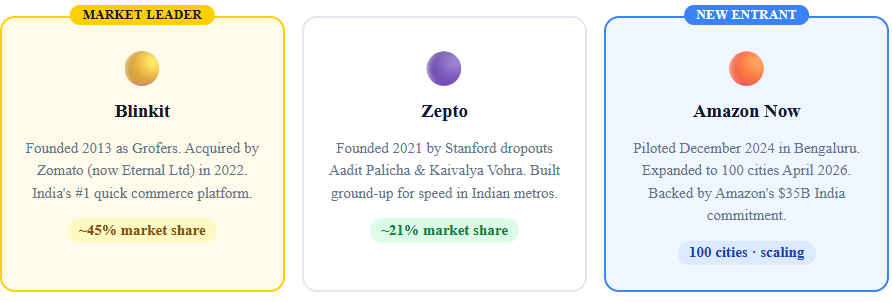
Blinkit started life as Grofers, India’s first major online grocery platform, before pivoting to quick commerce in 2021. After its acquisition by Zomato, it became the category leader — holding 45% of India’s quick commerce market, ahead of Swiggy Instamart at 27% and Zepto at 21%. Its revenue tells an equally striking story: analysts forecast Blinkit’s quick commerce sales will reach ₹268 billion in 2026, a fivefold jump from ₹52 billion in 2025.
Zepto was founded in April 2021 by two 19-year-old Stanford dropouts and built the dark store playbook that everyone else now follows. By early 2026, Zepto reported over 1,100 dark stores per IPO information filed with SEBI. Its focused metro strategy — depth over breadth — has made it the go-to choice for speed-obsessed urban shoppers.
Amazon Now is the newest and most ambitious entrant. Amazon Now will expand to 100 cities across India with deliveries in minutes, supported by over 1,000 micro-fulfilment centres, with more than 16,000 farmers supplying fresh produce directly to customers. This growth is backed by Amazon’s announcement of a ₹2,800 crore investment to strengthen its infrastructure and operations in India, as part of its broader $35 billion commitment planned through 2030.
Delivery Speed Comparison
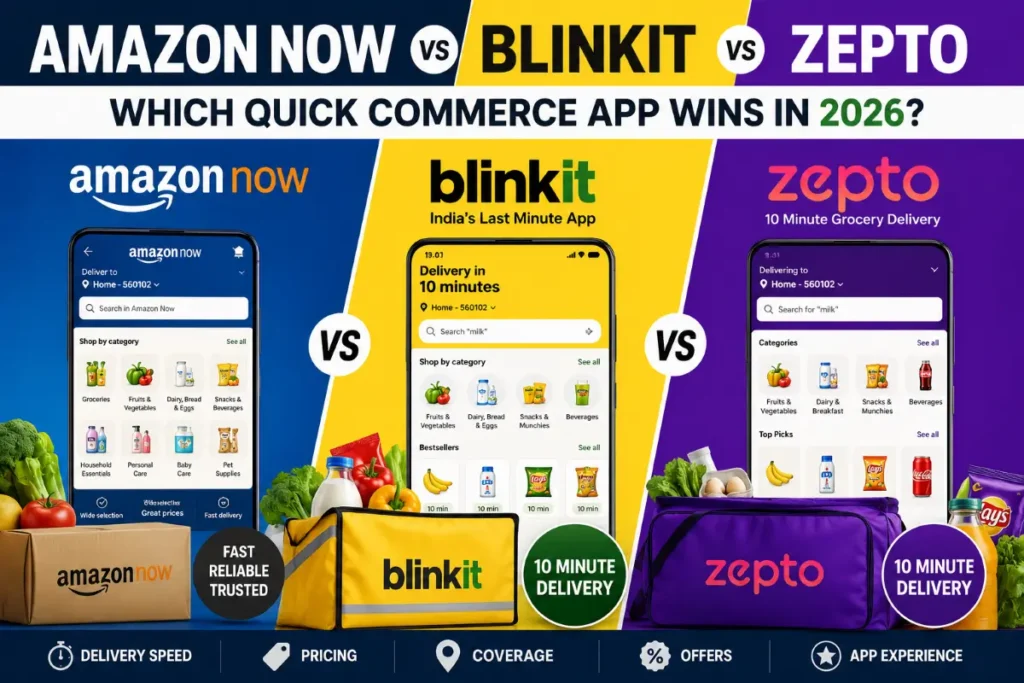
Speed is the whole point of quick commerce. Here is how the three platforms compare on actual delivery performance — not just marketing claims.
| Metric | Blinkit | Zepto | Amazon Now |
|---|---|---|---|
| Average delivery time | 10–15 min | Under 10 min | 15–30 min (scaling) |
| Reported fastest delivery | ~9 min | 8 min 47 sec | ~15 min |
| Fulfilment model | Dark stores | Dark stores | Micro-fulfilment centres (MFCs) |
| Stores / MFCs | 2,100+ dark stores | 1,100+ dark stores | 300 MFCs now → 1,000+ planned |
| On-time delivery rate | ~75% within 2-min of promised time | Avg 8 min 47 sec | Data not yet published |
| Order fill rate | Above 99% | High (inventory-led model) | Growing as network scales |
Zepto reports an average delivery time of 8 minutes and 47 seconds — impressive by any standard. This is achieved by positioning dark stores within 1.5 to 4 kilometres of customer clusters, with order picking optimised to under 60 seconds inside each store.
Blinkit reports that close to 75% of orders are delivered within a two-minute window of the promised delivery time, with an item fulfilment rate stated to be above 99%. These figures are disclosed by management rather than independently audited — but they reflect genuine operational maturity built over years of scaling.
Amazon Now is the youngest of the three and its speed metrics are still catching up. Micro-fulfilment centres are compact, technology-driven storage sites that operate within a larger logistics network — a different model from traditional dark stores. The integration with Amazon’s existing last-mile infrastructure is both an advantage (scale) and a constraint (not purpose-built for 10-minute delivery like dark stores are).
🏆
Speed winner: Zepto— by a narrow margin in metros. For raw delivery speed in cities where all three operate, Zepto’s dark store DNA gives it a slight edge. Blinkit is a close second and more consistent nationally. Amazon Now is still building toward competitive speed.
City & Area Coverage
City coverage is where the competitive picture changes dramatically — and where Amazon Now makes its strongest case.
| Coverage factor | Blinkit | Zepto | Amazon Now |
|---|---|---|---|
| Total cities | 20+ cities | ~10 metro cities | 100 cities |
| Tier-1 metros | Strong presence | Strong presence | Strong presence |
| Tier-2 cities | Expanding | Limited | Jaipur, Lucknow, Kanpur, Chandigarh, Ahmedabad, Amritsar, Mangalore, Panipat |
| Tier-3 cities | Limited | Not yet | Mysore, Meerut, Visakhapatnam, Kochi and more |
| Store expansion target | 3,000 dark stores by March 2027 | Deepening metro density | 1,000+ MFCs planned |
Blinkit has around 2,100 dark stores and has communicated it will open another 900 dark stores by March of 2027. Swiggy’s Instamart and Zepto have around 1,100–1,200 dark stores each. Blinkit’s strategy is focused on density in existing metros while gradually expanding outward.
Zepto has taken the opposite bet — stay hyperlocal in metros and build the densest possible network there before expanding. Each dark store stocks only 2,500–3,000 high-demand items to ensure packers can assemble an order in under 60 seconds. This tight focus on SKU count is what powers Zepto’s speed, but it also limits its addressable market.
Amazon Now’s 100-city expansion is the story of 2026. Customers in both metro and non-metro cities including Pune, Hyderabad, Chennai, Kolkata, Jaipur, Lucknow, Kanpur, Chandigarh, Ahmedabad, Meerut, Mysore, Panipat, Kochi, Amritsar, Mangalore, Visakhapatnam, Mumbai, Delhi NCR, and Bengaluru can now access Amazon Now.
The 83% opportunityIndia’s quick commerce sector currently serves around 2,600 pincodes and nearly 230 million people, which is about 17% of India’s population — meaning 83% of India is still untouched by quick commerce. Amazon Now’s 100-city expansion is the first serious attempt to close this gap.
Coverage winner: Amazon Now— by a significant margin. If you live outside a top metro, Amazon Now is currently your only real quick commerce option among the three. For metro users, all three compete directly on coverage.
Product Range & Categories
Blinkit made a significant strategic move in January 2026, revising its tagline from “10,000+ products delivered in 10 minutes” to “30,000+ products delivered at your doorstep” — a deliberate shift away from a time-bound delivery promise toward an expanded catalogue. This follows a discussion with the Union Ministry of Labour regarding pressure on gig workers from aggressive time targets.
Zepto’s philosophy is the opposite of catalogue breadth. Each dark store stocks only fast-moving essentials rather than comprehensive catalogs, enabling 3-minute order picking and 7-minute delivery. The trade-off is intentional — fewer SKUs means faster delivery. Zepto Café adds ready-to-eat food as a distinct category advantage.
Amazon Now’s product range is still ramping, but it carries a structural advantage no Indian competitor can match — access to Amazon.in’s enormous existing catalogue for same-day and next-day items alongside ultra-fast essentials. Amazon Now customers are buying fresh produce directly from farmers, adding personal care and hygiene products alongside grocery orders, and using quick commerce for last-minute fashion basics and small appliances.
Range winner: Blinkit for everyday quick commerce. Amazon Now wins on breadth if you count its full catalogue. Zepto wins for shoppers who want only the highest-velocity essentials delivered as fast as possible.
Pricing, Fees & Offers
Blinkit’s higher average order value of ₹709 versus Zepto’s ₹619 reflects its broader catalogue and the tendency of shoppers to add electronics and personal care to grocery runs. For brands selling on these platforms, Blinkit’s integration with Zomato gives cross-selling access to tens of millions of food delivery users — a unique advantage no competitor can replicate.
| Pricing factor | Blinkit | Zepto | Amazon Now |
|---|---|---|---|
| Free delivery threshold | Orders above ~₹199 | Orders above ~₹499 (max savings) | Free for Prime members |
| Handling/platform fee | Small handling fee applies | Small platform fee applies | Minimal for Prime users |
| Surge pricing | Yes — rain, festivals, peak hours | Yes — limited instances | Not yet widely reported |
| Subscription plan | Blinkit Pass (from ₹79/month) | Zepto Pass | Amazon Prime (existing subscribers benefit) |
| Bank card offers | HDFC, ICICI, SBI, Axis, Yes Bank | Multiple banks | Amazon Pay, HDFC |
| New user discount | Up to ₹150 off + free delivery | Strong new-user promos | Growing offer ecosystem |
| Avg order value (2026) | ₹709 (projected) | ~₹619 | Data not yet published |
Insider pricing tip Platform pricing is not always what it seems. Quick commerce apps often mark up products relative to MRP — the convenience fee is baked into product prices, not just delivery charges. Always compare the total order value across apps before placing a large grocery order. For Prime subscribers, Amazon Now is often the most cost-effective once delivery fees and cashback are factored in.
App Experience & Features
| Feature | Blinkit | Zepto | Amazon Now |
|---|---|---|---|
| Live order tracking | ✓ Real-time | ✓ Real-time ETA | ✓ Available |
| Scheduled delivery | ✓ Available | Limited | ✓ Available (leverages Amazon logistics) |
| Subscription plan | ✓ Blinkit Pass | ✓ Zepto Pass | ✓ Amazon Prime (most widely held) |
| Ready-to-eat / café | Limited | ✓ Zepto Café | Limited |
| Brand analytics tools | ✓ In-app ads | ✓ Zepto Atom (subscription analytics) | ✓ Amazon Seller Central integration |
| Cross-platform integration | ✓ Zomato integration (food + grocery) | Standalone | ✓ Amazon.in (1M+ same-day SKUs) |
| Dark patterns concern | Minimal reported | Minimal reported | ⚠️ Flagged by MediaNama (April 2026) |
Who Should Use Which App?
Stop reading here if you just want the bottom line. Here is the right app for every type of user. You can read complete details about best Quick commerce app in India.
| Your situation | Best app | Why |
|---|---|---|
| You live in a metro and want the fastest possible delivery | Zepto | Avg 8 min 47 sec; built ground-up for speed |
| You want the widest product range in one app | Blinkit | 30,000+ SKUs; electronics, medicines, personal care |
| You are in a tier-2 or tier-3 city | Amazon Now | Only player with 100-city coverage; others don’t reach you |
| You are an existing Amazon Prime member | Amazon Now | Free delivery, Amazon Pay cashback, trusted interface |
| You want fresh farm produce | Amazon Now | Direct sourcing from 16,000+ farmers; freshness advantage |
| You need medicines or pharmacy items quickly | Zepto | Zepto Superstore pharmacy; fastest delivery speed |
| You need electronics or gadgets in minutes | Blinkit | Widest electronics range in quick commerce |
| You want ready-to-eat food delivered fast | Zepto | Zepto Café — unique feature not matched by others |
| You are a brand wanting to sell on quick commerce | Blinkit first | 45% market share; highest order volume; Zomato user base |
| You order daily and want the cheapest effective cost | Blinkit or Zepto | Pass subscriptions + bank card stacking gives best savings |
The Big Picture — What This Means for India’s Quick Commerce Market
Amazon’s entry into quick commerce at scale is not just another product launch — it changes the competitive landscape in three important ways.
First, tier-2 and tier-3 cities become the new battleground. Blinkit and Zepto have built dominant positions in metros by focusing on density. Amazon’s move targets the next wave of digital consumption happening beyond metros — and Amazon knows it. With 83% of India still untouched by quick commerce, this is not a zero-sum game yet.
Second, the MFC model vs dark store model will be tested at scale. Micro-fulfilment centres are compact, technology-driven storage sites that operate within a larger logistics network. Amazon is betting this integrated model can achieve quick commerce speeds while also serving same-day and next-day delivery from the same infrastructure — something no pure-play quick commerce company can offer.
Third, fresh produce becomes a differentiator. Amazon Now customers are buying fresh produce directly from farmers, leading to better freshness and pricing. As quick commerce matures beyond emergency purchases, fresh food quality becomes a key loyalty driver.
India’s quick commerce market has scaled to over $10 billion in GMV and is projected to grow at over 40% annually through 2030. The consumer wins regardless of which platform wins — more competition means faster delivery, better prices, and wider access.
From a retail operations perspective Having spent 15+ years in retail supply chain, the most interesting thing about this three-way competition is not who delivers fastest today — it’s who builds the most profitable unit economics at scale. Blinkit’s shift to an inventory-led model is giving it better margin control. Zepto’s tight SKU focus keeps picking costs low. Amazon Now’s integration with its existing logistics network reduces last-mile capex significantly. All three are betting on different paths to the same destination: India’s daily shopping habit.
FAQ
Is Amazon Now faster than Blinkit?
Not currently in most cities. Blinkit and Zepto both deliver in 10–15 minutes on average thanks to mature dark store networks with 2,100+ and 1,100+ locations respectively. Amazon Now currently averages 15–30 minutes as it builds out its micro-fulfilment centre network. This gap will likely narrow as Amazon scales its 1,000+ MFC plan.
Which quick commerce app has the lowest delivery fee?
For existing Amazon Prime subscribers, Amazon Now offers the best effective delivery cost — free delivery on all orders. Blinkit and Zepto offer free delivery above minimum order thresholds (roughly ₹199 and ₹499 respectively), and both offer subscription plans for unlimited free delivery. For non-Prime users ordering regularly, Blinkit Pass or Zepto Pass subscriptions typically deliver the best savings.
Which app is best for tier-2 and tier-3 cities?
Amazon Now is the clear answer here. It is the only one of the three with a 100-city footprint that includes smaller cities. Blinkit covers 20+ cities and is expanding, but Zepto remains focused on metro markets. If you are in a city like Jaipur, Lucknow, Panipat, or Meerut, Amazon Now is likely your only option among these three.
Is Zepto better than Blinkit in 2026?
It depends on what you prioritise. For raw delivery speed in metros, Zepto’s average of under 10 minutes is ahead of Blinkit. But Blinkit has broader city coverage, a wider product range (30,000+ SKUs vs Zepto’s 2,500–3,000 per store), higher order volume, and a larger market share of around 45% vs Zepto’s 21%. For most shoppers, Blinkit is the more complete platform — but Zepto wins on the single dimension of delivery speed.
Does Amazon Now require Amazon Prime?
No — Amazon Now is available to all users, not just Prime members. However, Prime membership unlocks free delivery on Amazon Now orders, making it significantly more cost-effective for frequent shoppers. Non-Prime users pay standard delivery fees.
Which app is best for fresh groceries and vegetables?
Amazon Now has a structural freshness advantage: it sources fresh produce directly from over 16,000 farmers, which typically means shorter supply chains and fresher products. Blinkit and Zepto both offer quality fresh produce through their inventory-led models, but neither has this direct farm-to-customer sourcing at scale.
Final Verdict — 2026’s Quick Commerce Race Is Just Getting Started
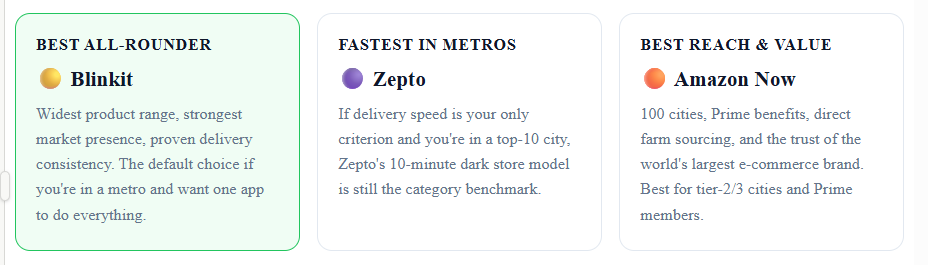
If you are choosing an app today, the answer is straightforward: Blinkit is the best all-rounder for metro shoppers, Zepto is the fastest for speed-first users, and Amazon Now is the best option for tier-2/3 cities and existing Prime subscribers.
But the more important story is what happens over the next 18 months. Amazon Now’s 100-city footprint and ₹2,800 crore infrastructure investment is not a defensive move — it is a long-term play for India’s daily shopping habit. Blinkit’s path to 3,000 dark stores by March 2027 is equally ambitious. Zepto’s IPO filings signal that scale, not just speed, is now the priority.
For consumers, this competition is unambiguously good news. The expectation bar has officially moved from same-day to same-minute — and the entire country, not just its metros, is about to benefit from that shift.
2 thoughts on “Amazon Now vs Blinkit vs Zepto: Which Quick Commerce App Wins in 2026?”