The rapid rise of quick commerce has completely reshaped how consumers buy daily essentials. What started as next-day delivery has evolved into 10–20 minute fulfillment, driven by changing consumer expectations and urban lifestyles.
If you’re exploring how to start a quick commerce business, you’re entering a high-growth but highly operationally complex space. Success here isn’t about launching an app—it’s about building a precision-driven supply chain, hyperlocal infrastructure, and efficient last-mile delivery system.
With over 15 years of experience across retail, e-commerce, grocery, and last-mile operations, I’ve seen firsthand how execution—not just strategy—determines success in this industry.
This guide breaks down everything you need to build a sustainable quick commerce business in India.
What is Quick Commerce?
Quick commerce (Q-commerce) refers to ultra-fast delivery of essential goods, typically within 10–30 minutes, using a network of dark stores (micro-warehouses) located close to customers.
Key Characteristics:
- Hyperlocal delivery radius (1–3 km)
- Limited but high-demand SKU assortment
- High-frequency purchases
- Real-time inventory management
Why Start a Quick Commerce Business?
Market Opportunity
India’s quick commerce market is growing rapidly due to:
- Urban time constraints
- Smartphone penetration
- Demand for convenience
- Shift toward instant gratification
Consumer Behavior Shift
Customers today prefer:
- Ordering small baskets frequently
- Paying a premium for speed
- Reliable availability over discounts
Business Models in Quick Commerce
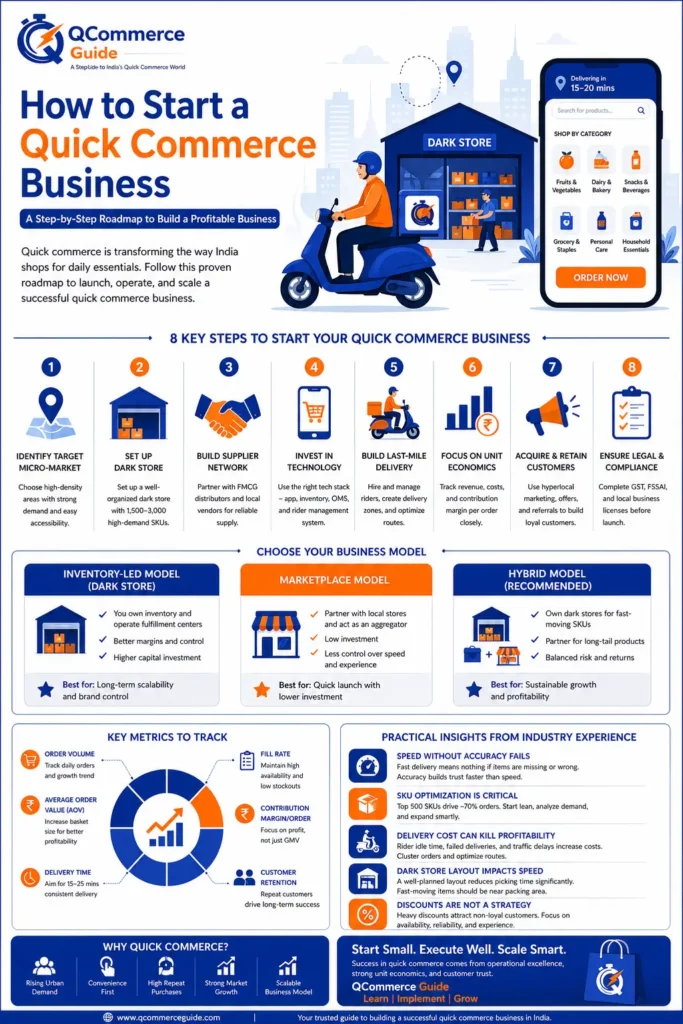
1. Inventory-Led Model (Dark Store Model)
You own inventory and operate fulfillment centers.
Pros:
- Better margins
- Full control over operations
- Faster delivery
Cons:
- High capital investment
- Inventory risk
2. Marketplace Model
You partner with local stores and act as an aggregator.
Pros:
- Low investment
- Faster to launch
Cons:
- Poor control over speed
- Inconsistent customer experience
3. Hybrid Model (Recommended)
Combine both:
- Dark stores for fast-moving SKUs
- Marketplace for long-tail products
How to Start a Quick Commerce Business

Step 1: Identify Target Micro-Market
Your success depends on location selection.
Focus on:
- High-density residential areas
- Working professionals
- Gated societies
Start small:
- 1–2 km delivery radius
- One cluster at a time
Step 2: Set Up a Dark Store
Dark stores are the backbone of quick commerce.
Ideal Setup:
- Size: 800–1500 sq ft
- SKUs: 1500–3000
- Layout: Optimized for fast picking
Key Categories:
- Grocery staples
- Dairy & bakery
- Snacks & beverages
- Personal care
- Ready-to-eat
Step 3: Build Supplier Network
Strong procurement ensures availability.
You’ll need:
- FMCG distributors
- Local vendors for fresh items
- Direct brand partnerships (as you scale)
Focus on:
- Fast replenishment cycles
- Negotiated margins
- Demand-based stocking
Step 4: Invest in Technology
Technology is not optional—it’s your core infrastructure.
Essential Components:
- Customer mobile app
- Inventory management system
- Order management system
- Rider tracking app
Options:
- Custom build (₹10–30 lakh)
- SaaS-based quick commerce platforms
Step 5: Build Last-Mile Delivery
Delivery defines your brand promise.
Execution Tips:
- Use gig riders initially
- Create delivery zones
- Optimize routes using clustering
Target Metrics:
- Delivery time: 15–25 minutes
- Order processing: < 5 minutes
Step 6: Pricing & Unit Economics
This is where most founders struggle.
Revenue Streams:
- Product margin (10–25%)
- Delivery fees
- Platform/convenience fees
- Brand promotions
Major Costs:
- Delivery payouts
- Rent
- Inventory holding
- Discounts
👉 Focus on contribution margin per order, not just GMV.
Step 7: Customer Acquisition Strategy
Start hyperlocal—don’t burn money on broad ads.
Effective Channels:
- WhatsApp marketing
- Society activations
- Referral programs
- Introductory free delivery
Retention > Acquisition
Repeat customers drive profitability.
Step 8: Legal & Compliance
In India, ensure:
- GST Registration
- FSSAI License
- Shop & Establishment License
Practical Insights from Industry Experience
This is where theory meets reality.
After managing retail and last-mile operations for over a decade, here are some ground-level truths:
1. Speed Without Accuracy Fails
Fast delivery means nothing if:
- Items are missing
- Wrong products are delivered
👉 Accuracy builds trust faster than speed.
2. SKU Optimization is Critical
Many beginners overstock.
In reality:
- Top 500 SKUs drive ~70% orders
- Long-tail inventory blocks capital
👉 Start lean, expand based on demand.
3. Delivery Cost Can Kill Profitability
Most businesses underestimate:
- Rider idle time
- Failed deliveries
- Traffic delays
👉 Cluster orders and optimize routing early.
4. Dark Store Layout Impacts Speed
Poor layout = slow picking.
Best practice:
- Fast-moving items near packing area
- Logical category grouping
5. Discounts Are Not a Strategy
Heavy discounting attracts:
- Non-loyal customers
- Low-margin orders
👉 Focus on:
- Availability
- Reliability
- Experience
Real-World Scenario
Let’s say you launch in a Gurgaon residential cluster:
- 1 dark store
- 2000 SKUs
- 2 km radius
Initial challenges:
- Low order density
- High delivery cost per order
- Stockouts
What works:
- Target top societies
- Push repeat usage
- Optimize SKU mix weekly
Within 3–6 months:
- Order density improves
- Delivery cost reduces
- Margins stabilize
Common Mistakes to Avoid
- Launching too many locations early
- Over-investing in inventory
- Ignoring unit economics
- Chasing speed over consistency
- Poor demand forecasting
Scaling Strategy
Once stable:
Phase 1:
- Optimize unit economics
- Increase repeat orders
Phase 2:
- Expand to nearby clusters
Phase 3:
- Introduce private labels
- Improve margins
Future of Quick Commerce in India
The industry is evolving toward:
- Dark store automation
- AI-driven inventory planning
- Private label dominance
- Profitability-focused growth
FAQ Section
1. Is quick commerce profitable in India?
Yes, but only with strong unit economics and high order density. Profitability comes after operational optimization.
2. How much investment is required to start?
A basic setup can cost ₹15–50 lakh depending on scale, technology, and inventory.
3. What is the ideal delivery time?
Start with 30 minutes. Optimize to 15–20 minutes after stabilizing operations.
4. How many SKUs should I start with?
Begin with 1000–2000 SKUs focused on high-demand products.
5. Can I start without a dark store?
Yes, using a marketplace model—but delivery speed and experience may suffer.
Conclusion
Starting a quick commerce business is not just about speed—it’s about operational excellence, disciplined execution, and smart scaling.
If you’re serious about building in this space:
- Start small
- Focus on unit economics
- Build repeat customers
- Optimize before scaling
From my experience, the businesses that win are not the fastest to launch—but the most consistent in execution.
1 thought on “How to Start a Quick Commerce Business in India (Step-by-Step Guide)”