Quick commerce in India is no longer an emerging trend—it’s becoming a core retail infrastructure layer. What started as 10-minute grocery delivery is now evolving into a multi-category, tech-driven, high-frequency commerce ecosystem.
This article explains where the industry is heading, what will drive growth, and what businesses must do to stay competitive.
Explosive Market Growth (With Reality Check)
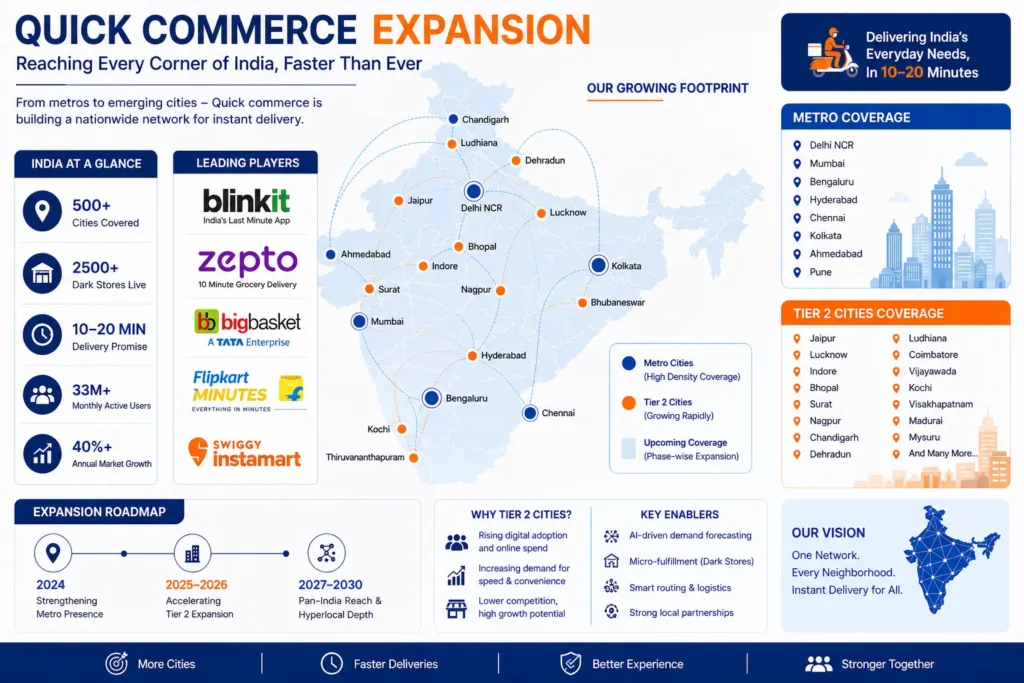
India’s quick commerce market is expanding rapidly and is expected to reach multi-billion-dollar scale over the next few years. Growth is driven by increasing urban demand, digital adoption, and changing consumer behavior.
However, rapid expansion comes with challenges:
- High operational costs
- Delivery expenses
- Inventory management complexity
The key shift ahead will be from growth-focused strategies to profitability-focused models.
Expansion Beyond Metro Cities
Quick commerce is moving beyond metros into Tier 2 and Tier 3 cities.
Key implications:
- New customer base with rising demand
- Lower competition initially
- Higher logistics complexity
Future growth will largely come from non-metro markets, but execution will require strong local understanding and cost control.
From Groceries to Multi-Category Commerce
Quick commerce is no longer limited to groceries.
Expanding categories include:
- Electronics and accessories
- Medicines and healthcare
- Beauty and personal care
- Toys, gifting, and pet products
This shift is changing the model from need-based purchases to impulse-driven consumption.
Faster Delivery Becomes Standard
Delivery expectations are now between 10–20 minutes in urban areas.
This is enabled by:
- Dense dark store networks
- Improved route optimization
- Hyperlocal delivery clustering
The competitive advantage will depend on consistency, not just speed.
Technology Will Define Market Leaders
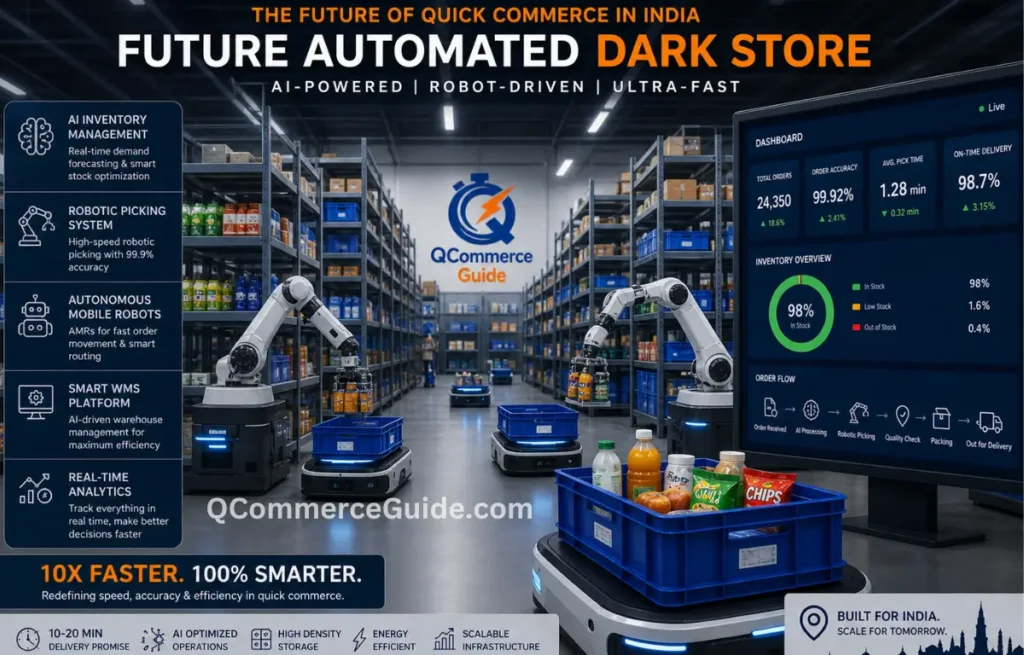
Technology is becoming the backbone of quick commerce operations.
Key developments include:
- AI-based demand forecasting
- Automated inventory systems
- Smart route optimization
- Real-time analytics
Companies that invest in technology and integrate it with operations will achieve better margins and efficiency.
Rapid Expansion of Dark Stores
Dark stores will continue to grow across cities.
Key trends:
- Smaller delivery radiuses
- Higher SKU efficiency
- Faster order processing
These micro-fulfillment centers will function as high-efficiency retail hubs rather than traditional warehouses.
Profitability Will Be the Main Focus
The industry is shifting from discount-led growth to margin-driven strategies.
Key focus areas:
- Increasing average order value
- Reducing delivery costs
- Expanding private label products
- Improving operational efficiency
Sustainable unit economics will determine long-term success.
Changing Consumer Behavior
Consumer habits are evolving significantly.
Key patterns:
- Frequent small orders
- Preference for convenience over price
- High reliance on instant delivery
Quick commerce is becoming a daily habit rather than an occasional service.
Increasing Competition
Competition is intensifying with both startups and large companies expanding aggressively.
Expected outcomes:
- Market consolidation
- Stronger competition on efficiency
- Increased focus on customer retention
Only companies with strong execution capabilities will survive.
Sustainability and Regulation
Sustainability is becoming an important factor.
Key concerns:
- Packaging waste
- Environmental impact of deliveries
- Pricing transparency
Future focus will include:
- Eco-friendly packaging
- Efficient delivery batching
- Regulatory compliance
Practical Insights from Industry Experience
Based on real-world retail and last-mile operations experience, the following insights are critical:
Speed Without Accuracy Fails
Customers may tolerate slight delays, but not incorrect or missing orders. Accuracy builds long-term trust.
Tier 2 Expansion is Operationally Challenging
Lower order density and higher delivery costs make non-metro expansion complex.
SKU Optimization is Critical
A small percentage of SKUs drives most of the demand. Over-expansion of inventory leads to inefficiencies.
Dark Store Efficiency Drives Profitability
Store layout, picking speed, and inventory placement directly impact operational costs.
Customer Retention is More Valuable Than Acquisition
Repeat customers are the foundation of sustainable growth and profitability.
Key Trends Summary
| Trend | Impact |
|---|---|
| Expansion to Tier 2 and Tier 3 cities | Major growth driver |
| Multi-category expansion | Higher basket value |
| Technology adoption | Improved efficiency |
| Dark store scaling | Faster delivery |
| Profitability focus | Industry consolidation |
| Changing consumer behavior | Long-term demand |
FAQ
1. Is quick commerce the future of retail in India?
Yes, especially for high-frequency and convenience-driven purchases.
2. Will quick commerce replace traditional e-commerce?
No, but it will dominate daily-use and urgent purchase categories.
3. Is the business profitable?
It can be profitable with strong unit economics and operational efficiency.
4. Which markets will drive growth?
Tier 2 and Tier 3 cities will play a major role in future expansion.
5. What is the biggest challenge?
Balancing delivery speed with operational costs and profitability.
Conclusion
The future of quick commerce in India is strong but highly execution-driven.
Over the next few years, the industry will shift:
- From speed to efficiency
- From growth to profitability
- From metro focus to nationwide expansion
Businesses that focus on operational discipline, cost control, and customer retention will succeed in the long run.
Image Prompt Ideas
- Future automated dark store with robotics and AI inventory system in India
- Quick commerce expansion map showing metro and Tier 2 city coverage
- Evolution of quick commerce from grocery delivery to multi-category platform
1 thought on “Future of Quick Commerce in India (2026–2030)”