Why Blinkit vs Zepto vs Instamart Matters Today
The rapid rise of quick commerce has fundamentally reshaped how urban India shops for groceries and daily essentials. What started as same-day delivery has now evolved into 10-minute delivery expectations, driven by players like Blinkit, Zepto, and Instamart.
If you’re trying to decide between these apps—or understand how they operate behind the scenes—this guide will break down Blinkit vs Zepto vs Instamart from a real-world, operational perspective.
Having worked across retail supply chains, e-commerce, and last-mile delivery since 2013, I’ve seen firsthand how these models succeed—or fail—based on execution, not just marketing.
What is Quick Commerce?
Quick commerce (Q-commerce) refers to ultra-fast delivery of goods, typically within 10–30 minutes, using:
- Dark stores (micro-warehouses)
- Hyperlocal logistics
- Optimized inventory systems
- Real-time demand forecasting
The success of Blinkit, Zepto, and Instamart depends heavily on how well they manage these operational pillars.
Blinkit vs Zepto vs Instamart: Overview Comparison
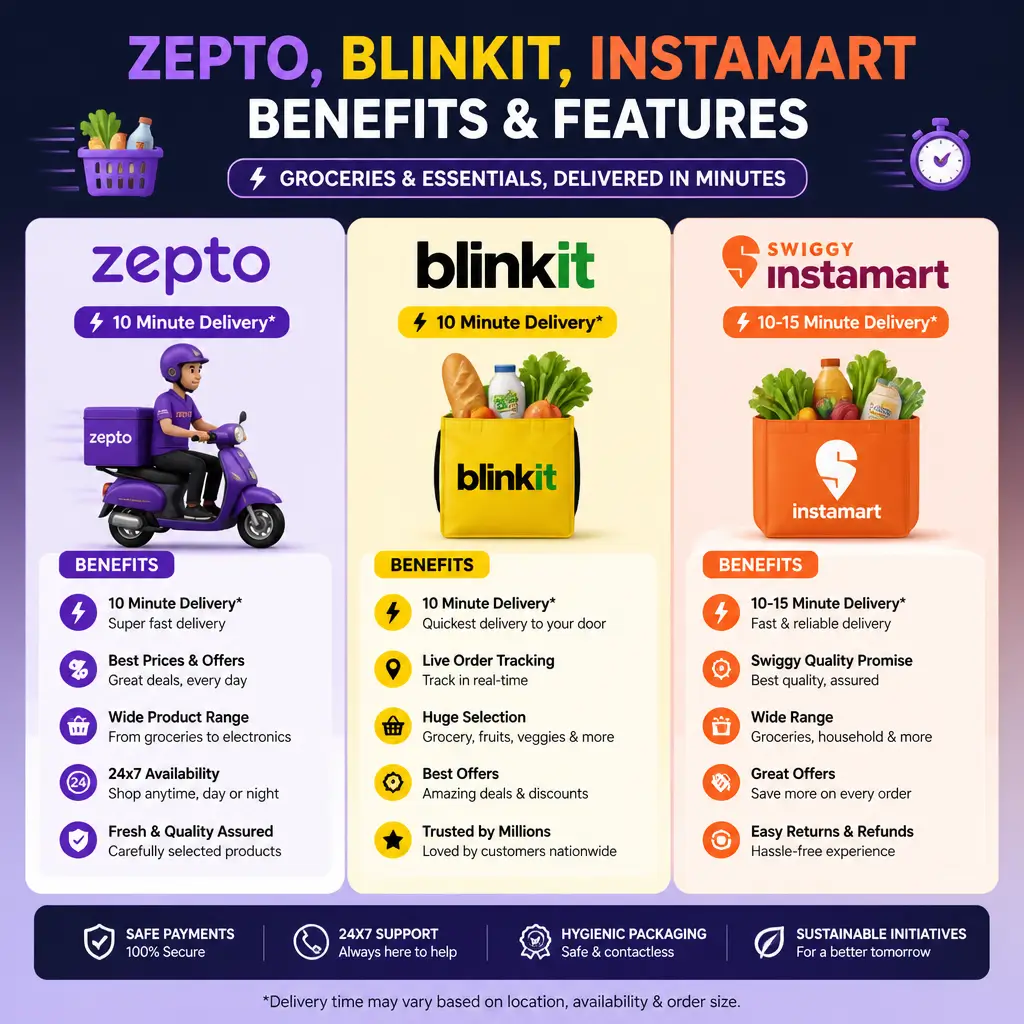
| Feature | Blinkit | Zepto | Instamart |
|---|---|---|---|
| Delivery Speed | 10–15 min | 10 min | 15–25 min |
| Parent Company | Zomato | Independent | Swiggy |
| Strength | Reliability | Speed | Ecosystem |
| Dark Store Density | Very High | High | Moderate |
| Product Range | Wide | Focused | Balanced |
| Pricing | Competitive | Slightly premium | Competitive |
Blinkit vs Zepto vs Instamart: Delivery Speed & Fulfillment
Blinkit: Consistent Speed at Scale
Blinkit excels in maintaining consistent delivery timelines, even during peak hours.
- Strong dark store network
- Better rider allocation systems
- Mature operations
Reality check: Speed isn’t always 10 minutes—but reliability is high.
Zepto: Built for Speed First
Zepto designed its entire model around ultra-fast fulfillment.
- Highly optimized store layouts
- Limited SKU strategy (faster picking)
- Youth-focused brand positioning
Trade-off: Slightly higher prices and occasional stock limitations.
Instamart: Balanced but Slightly Slower
Instamart focuses more on integration with food delivery.
- Works well for bundled orders
- Slightly longer delivery windows
- Strong in tier-1 and tier-2 expansion
Inventory & Product Availability
Blinkit
- Largest SKU range
- Better availability of niche products
- Strong supplier relationships
Zepto
- Focused assortment
- Faster picking due to fewer SKUs
- Sometimes limited options in non-core categories
Instamart
- Balanced catalog
- Strong FMCG partnerships
- Good availability in staples
Pricing & Offers: Which App is More Cost-Effective?
From my experience in retail pricing:
- Blinkit → Best mix of discounts + availability
- Zepto → Premium perception, fewer deep discounts
- Instamart → Frequent offers via Swiggy ecosystem
Hidden Cost Factors:
- Delivery fees during peak hours
- Surge pricing
- Membership programs
User Experience & App Design
Blinkit
- Clean interface
- Easy repeat ordering
- Fast checkout
Zepto
- Modern UI
- Youth-centric design
- Quick navigation
Instamart
- Integrated within Swiggy
- Great for multi-category usage
- Slightly cluttered at times
Dark Store Network & Operations
This is where the real game is won.
Blinkit
- Highest density of dark stores
- Better geographic coverage
- Lower delivery radius → faster service
Zepto
- Smart placement strategy
- Efficient store design
- Rapid expansion model
Instamart
- Growing network
- Slightly less dense than Blinkit
- Focus on scalability over speed
Practical Insights from Industry Experience
After managing retail operations and observing quick commerce closely, here are some ground realities most users don’t see:
1. Speed Comes from Inventory Discipline
Fast delivery is not magic—it’s inventory accuracy.
If a dark store has:
- Poor stock tracking
- Misplaced items
- Untrained pickers
→ Delivery time increases instantly.
2. Dark Store Location is Everything
A 10-minute promise depends on:
- Store within 2–3 km radius
- Traffic conditions
- Rider availability
This is why Blinkit often wins—it invested early in store density.
3. SKU Strategy Impacts Speed
- Zepto keeps fewer SKUs → faster picking
- Blinkit offers more SKUs → slightly slower but more choice
This is a classic retail trade-off:
Assortment vs efficiency
4. Rider Efficiency is a Major Bottleneck
Even with perfect inventory:
- Rider delays
- Traffic
- Order batching
can impact delivery.
Companies constantly optimize:
- Route algorithms
- Rider incentives
- Peak hour pricing
5. Profitability is Still a Challenge
Quick commerce is operationally expensive:
- High rent for dark stores
- Rider costs
- Inventory holding
This is why:
- Free delivery is limited
- Minimum order values exist
Real-World Usage Scenarios
Scenario 1: Late-Night Grocery Need
- Best choice: Blinkit
- Reason: Higher availability + reliability
Scenario 2: Urgent Item (10-min priority)
- Best choice: Zepto
- Reason: Speed-focused operations
Scenario 3: Ordering Food + Groceries Together
- Best choice: Instamart
- Reason: Swiggy integration
Scenario 4: Bulk Weekly Shopping
- Best choice: Blinkit or Instamart
- Reason: Better assortment
Blinkit vs Zepto vs Instamart: Pros & Cons
Blinkit
Pros
- Reliable delivery
- Wide product range
- Strong infrastructure
Cons
- Slight delays during peak
- Delivery charges fluctuate
Zepto
Pros
- Fastest delivery
- Efficient operations
- Clean app
Cons
- Limited product range
- Slightly higher pricing
Instamart
Pros
- Integrated ecosystem
- Good offers
- Balanced catalog
Cons
- Slower than competitors
- App experience can improve
Which App Should You Choose?
It depends on your priority:
- Speed → Zepto
- Reliability → Blinkit
- Convenience → Instamart
There is no one-size-fits-all winner—each app serves a different use case.
FAQ: Blinkit vs Zepto vs Instamart
1. Which app delivers the fastest?
Zepto is generally the fastest due to its optimized operations and limited SKU model.
2. Which app is cheapest?
Blinkit and Instamart usually offer better discounts, making them more cost-effective.
3. Which app has the most products?
Blinkit has the widest product range among the three.
4. Are 10-minute deliveries realistic?
Yes, but only when:
- You are close to a dark store
- Demand is moderate
- Inventory is available
5. Which app is best in smaller cities?
Instamart is expanding aggressively in tier-2 cities, making it a strong option.
Conclusion: Final Verdict on Blinkit vs Zepto vs Instamart
The competition between Blinkit, Zepto, and Instamart is not just about speed—it’s about operational excellence, inventory control, and last-mile execution.
From my experience in retail and quick commerce:
- Blinkit wins on consistency and scale
- Zepto leads in speed innovation
- Instamart offers ecosystem convenience
If you’re a regular user, the smartest approach is to use all three strategically based on your need at that moment.
4 thoughts on “Blinkit vs Zepto vs Instamart: The Ultimate Quick Commerce Comparison (2026 Guide)”